
The VAR High Bar Debate: Why Fans and Referees Never Agree
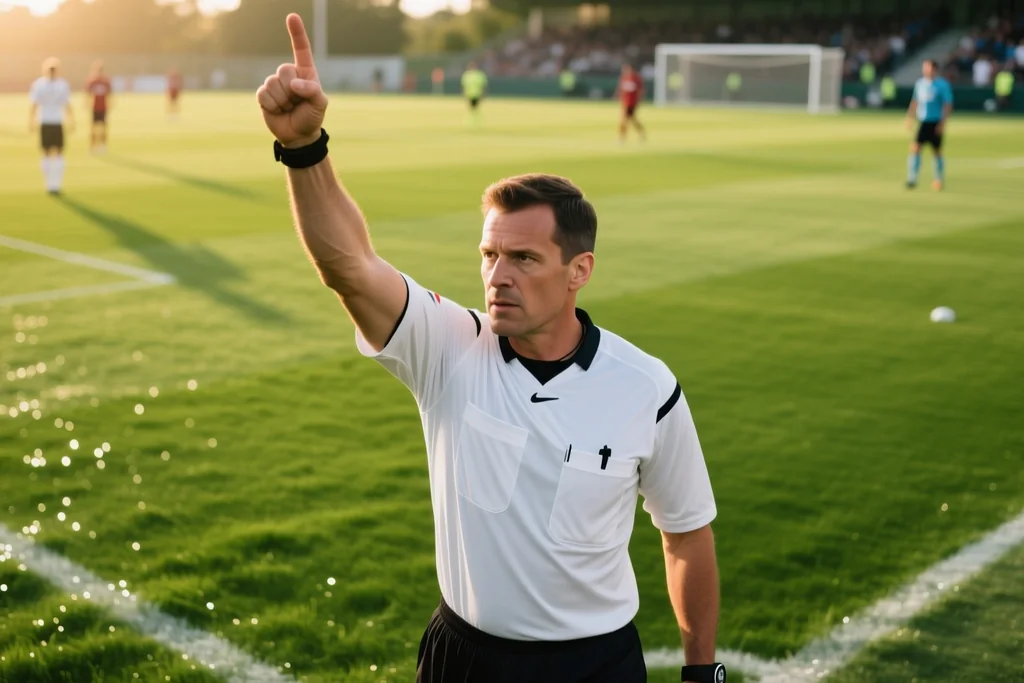
The VAR high bar is the most persistent argument in modern football, and it is not about cameras, algorithms or the number of screens in a room. It is about how much uncertainty a competition is willing to accept: referees are briefed to intervene only for a clear and obvious error, and supporters who watch three replays expect almost everything to be overturned. That gap is a design choice rather than a failure.
The reasoning behind the high bar is preserving authority. If video officials corrected every borderline judgement, the referee on the pitch would gradually become a spectator waiting for instructions, and the match would turn into a sequence of stoppages. Football has never wanted that, which is why the protocol deliberately leaves the on-field decision standing unless the evidence is overwhelming.
What the two sides of the VAR high bar are asking for
The supporter's position is straightforward: a competition has the technology, so it should use it to reach the right answer. The official's position is subtler. Most decisions in football are not right or wrong, they are more or less defensible, and a system that intervenes in every defensible-but-debatable case has not removed disagreement. It has moved it into a video room where nobody can see it.
- Supporters want: consistency between matches and no obvious errors surviving the review.
- Referees want: the authority to make decisions at full speed without constant second-guessing.
- Leagues want: predictable match length and fewer headlines about officiating.
- Clubs want: the same standard applied to them as to their opponents.
- Broadcasters want: a decision that can be explained in under a minute of airtime.
Why the bar feels inconsistent
Because it is applied to two different kinds of question. Factual matters such as offside and ball position are settled by evidence, so a wrong call is corrected whenever it is found. Judgement matters such as force, contact and arm position pass through the threshold, which means two similar-looking incidents can produce different outcomes without anyone breaking the protocol.

The VAR intervention threshold: how the bar is communicated to officials
Refereeing bodies do not hand out a written definition of clear and obvious. They build a shared standard with video libraries: hundreds of clips, marked by every official, compared against the expectation the competition has set. A decision that appears in the "no intervention" column of those sessions becomes the working reference point for the season.
That process explains why interpretation drifts. When a series of high-profile incidents produces a public reaction, the clips are re-marked and the working reference point moves. Nothing in the lawbook changes, but what officials consider reviewable can shift between August and May.
| Perspective | Verdict | Reasoning |
|---|---|---|
| Referee on the pitch | No foul | Contact was minimal at full speed |
| Video assistant referee | No intervention | Not a clear and obvious error |
| Coaching staff | Clear penalty | Contact was made before the ball |
| Neutral supporter | Depends on the shirt | Reaction shaped by allegiance |
What has actually improved
Two changes have narrowed the gap without touching the threshold. The first is transparency: released audio and referee announcements mean supporters can hear why a decision was reached. The second is speed, because semi-automated offside and better camera coverage have removed the long reviews that used to feel like indecision.
What a lower bar would actually change
If competitions instructed their video teams to intervene on any defensible error rather than only a clear one, the immediate effect would be more overturned decisions and far more stoppages. Defenders would learn quickly that any contact in the penalty area is worth appealing, and the number of checks per match would rise sharply.
The longer-term effect is the one that worries officiating bodies. Once the video team intervenes routinely, referees stop committing to decisions at full speed, because every call is a provisional answer waiting to be corrected. Match control starts to depend on a room full of officials rather than on the referee standing in the middle of it.
Supporters who want a lower bar are not wrong to want it. They are asking for a different sport, with more accuracy and more interruption, and that is a legitimate preference. What they are not asking for is a small technical fix.
The remaining dissatisfaction is structural, and it will not be solved by better technology. Either a competition accepts some errors in exchange for a match that keeps moving, or it accepts long stoppages in exchange for more correct outcomes. Every league chooses a point on that line, and every league is criticised for the point it chose.
Why the argument is worth having properly
Most VAR debates are conducted as if the system were broken. In practice the system does exactly what its protocol says, and the disagreement is about the protocol itself. Changing the threshold would be a legitimate decision, and it would produce a genuinely different sport.
The mechanics behind the threshold are set out in the clear and obvious error test, and the categories it applies to are listed in what VAR can and cannot review. A well-documented example of the process failing is analysed in the anatomy of a VAR breakdown.
Once the design choice is visible, the argument becomes more interesting than a complaint. Football is not debating whether video review works; it is debating how much it wants to interrupt the game to use it.
Read next
Tottenham vs Liverpool VAR: Anatomy of a Breakdown
The mistake was not a wrong line or a bad camera angle. It was a sentence spoken too late, and it changed how reviews are run.
2026-09-22
The Beach Ball Goal: Outside Interference and the Law
An inflatable ball, a deflection and a goal that stood. The law had no answer, so the law was changed.
2026-09-08
The Handball Law Changes: How One Rule Kept Swinging
No law has changed direction as often as handball. Each revision answered one complaint and created the next.
2026-08-31