
VAR Rules Explained: What Can and Cannot Be Reviewed
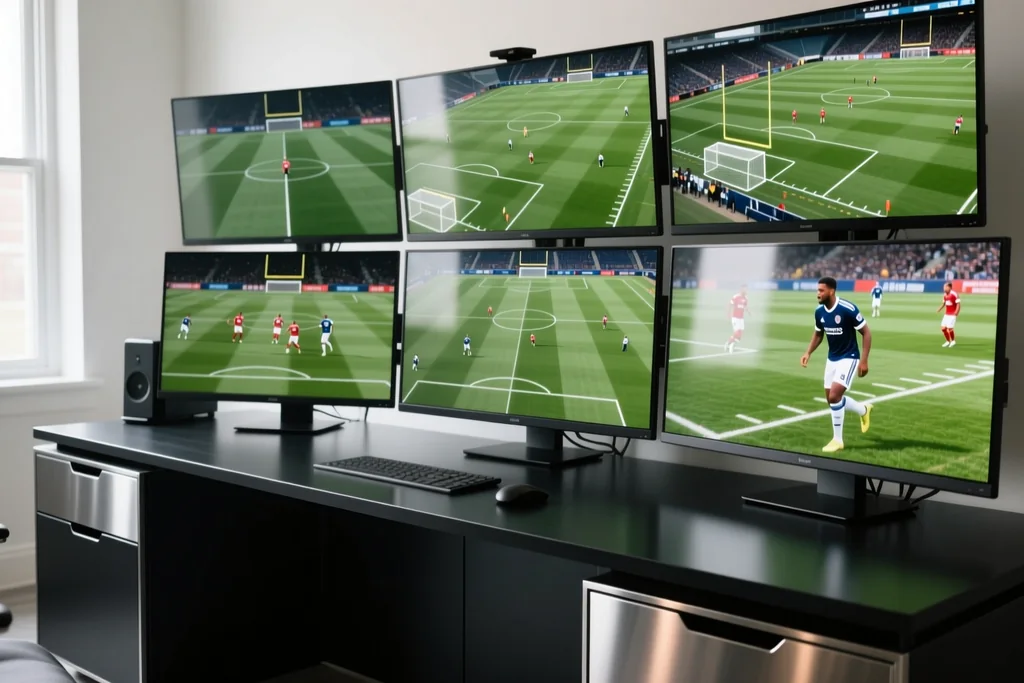
The VAR rules explained properly begin with a correction: the video assistant referee is not a second referee. VAR does not officiate the match, does not blow the whistle and does not decide anything independently of the referee on the pitch. It exists to correct a narrow set of clear mistakes, in a narrow set of reviewable decisions, and the list is shorter than most supporters assume.
That narrowness is the design, not a flaw. The protocol lists four categories that can be reviewed, and anything outside those categories is untouchable no matter how wrong it looks on the twentieth replay. What the list does contain has grown at the margins: since the 2026/27 edition the protocol reaches a dismissal produced by a second caution that was clearly wrong, which used to sit outside it entirely.
What can VAR review: the four reviewable decisions
Every VAR intervention in a professional match falls into one of four headings. Two of them are about goals, one is about penalties and fouls inside the area, and one is about identity. If a decision does not map onto this list, the review cannot begin.
- Goal or no goal. Whether the whole ball crossed the line, whether there was an offence in the build-up, and whether the ball went out of play before the attack.
- Penalty or no penalty. Including incidents that happened just outside the penalty area where the referee gave a spot kick in error.
- Direct red card. Sending-off offences, and since the 2026/27 edition a red card shown for a second caution that was clearly wrong. The review exists to correct the dismissal, not to re-judge every booking on its own.
- Mistaken identity. Where the wrong player has been cautioned or dismissed, and the referee needs to correct who the sanction applies to.
What is deliberately excluded
Cautions on their own remain outside the protocol: reviewing every borderline booking would turn matches into conferences, so a yellow card that stands alone is not a reviewable decision. What the 2026/27 edition added is the consequence — where a clearly mistaken second caution has already removed a player, the protocol now allows the video team to look at it. Free kick decisions outside the penalty area, including most offside calls that do not lead directly to a goal, are handled differently and are not reviewed in the same way.

VAR rules and regulations: the two thresholds inside the protocol
Reviewable does not mean automatic. Once an incident falls into one of the four categories, the video team applies a threshold before recommending a review. That threshold is a clear and obvious error, or a serious missed incident that nobody on the field saw. A marginal call that the referee judged at the time will normally survive, because the protocol assumes the on-field decision is the correct starting point.
This is why VAR appears to protect some decisions and punish others. The threshold is not a measure of whether the decision was right, it is a measure of whether the error was demonstrable from the footage. A hairline offside is demonstrable, because the line is objective. A subjective judgement about whether a shoulder charge was excessive usually is not.
| Decision | Reviewable? | Why |
|---|---|---|
| Goal, including build-up offences | Yes | Directly changes the score |
| Penalty awarded or not awarded | Yes | High-impact decision inside the area |
| Direct red card, including a dismissal from a mistaken second caution | Yes | Dismissal for the rest of the match |
| Wrong player sanctioned | Yes | Correcting identity, not judgement |
| Second yellow card considered on its own | No | A booking is not re-judged in isolation |
| Ordinary free kick outside the area | No | Low-impact or handled elsewhere |
| Throw-in or corner awarded to the wrong team | No | Restart decisions are not reviewable |
What happens after a review
If the video team concludes that a clear error has occurred, the referee is asked to look at the footage at the side of the pitch, or in a few cases accepts the evidence without a monitor trip. Reviewable on video only are objective matters such as offside lines and the position of the ball. Everything involving judgement generally sends the referee to the screen, where the final call remains theirs.
The communication around those decisions has changed too. In several competitions the referee now announces the outcome to the crowd after a review, which is a broadcast improvement rather than a change in the law.
Why the list stays short
A wider list would be a different sport. Reviewing every foul would stop matches constantly, and it would also change the role of the referee from a decision-maker to a technician waiting for a message. The four categories were chosen because they are the decisions where a mistake has an immediate, measurable effect on the result.
The procedure itself is worth reading next: the VAR protocol step by step, then the threshold that governs it in the clear and obvious error test. For the offside side of the system, semi-automated offside technology explains how the line is built.
What a review does to the match around it
A review does not happen in isolation. Play has usually stopped, players have gathered around the referee, and both benches are watching a stadium screen that may or may not show the same angles as the monitor. Coaches use the pause to talk to their teams, which gives a review a tactical consequence as well as a disciplinary one.
The referee's body language through the delay carries more weight than the eventual signal. A referee who keeps control of the conversation, who keeps players at a distance and who explains the process as it unfolds tends to emerge from a review with their authority intact, whatever the outcome.
Supporters, meanwhile, are asked to trust a decision they cannot see being made. That is why several competitions now show the review on the big screen and allow the referee to announce the final call over the public address system, which converts a private process into a public one.
Four categories, two thresholds, one referee. Once that structure is clear, most VAR confusion disappears, and what remains is an argument about judgment — which is a much better argument to have.
Read next
The Clear and Obvious Error Test: Why VAR Stays Silent
Two words in the protocol do most of the work: clear and obvious. They are also the reason a decision you hate can survive a video review.
2026-09-14
The VAR Protocol, Step by Step: Check, Review, Call
Every review follows the same sequence, and it starts before anyone in the stadium knows a decision is being examined at all.
2026-09-06
Semi-Automated Offside Technology, Explained Simply
Semi-automated offside does not replace the referee. It hands the VAR an offside line far faster than a manual drawing, and the decision stays human.
2026-08-26