
Semi-Automated Offside Technology, Explained Simply
Semi-automated offside technology is the most over-explained and least understood system in modern football, and the word semi is the important one. The technology does not decide whether a player is offside: it builds the offside line for the video assistant referee far faster than a manual drawing allows, and a human being still makes the call. This guide covers how the system builds a decision, where it still struggles, and what changes for the watching public.
The system was introduced to international football at the 2022 World Cup in Qatar, and it has since spread through continental club competitions and domestic leagues. What it shortens is the build-up: the line is assembled from tracking data and handed to the officials, who still make the decision.
Offside technology: how the system builds a decision
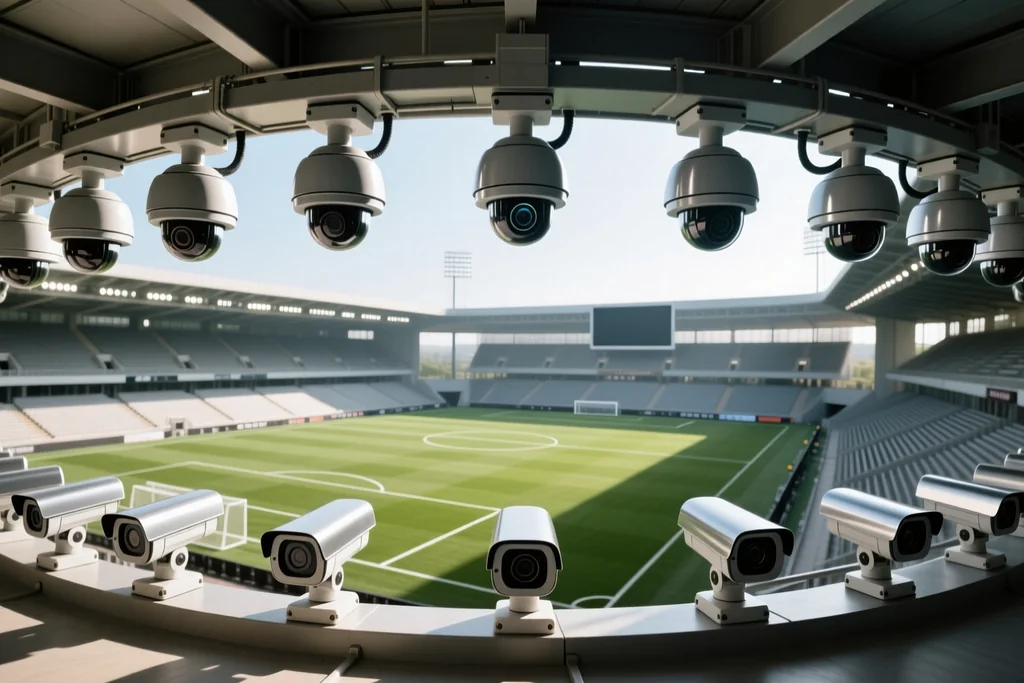
The technology combines three inputs: a set of tracking cameras around the stadium, a sensor inside the match ball, and a software model of each player's body. The cameras follow every player at high frequency and record the position of limbs, while the ball sensor identifies the exact frame in which the ball was last touched by the passer.
Once the kick point is identified, the system constructs a three-dimensional picture of the relevant attacking and defending players and places the offside line against that frame. The margin is measured, the alert goes to the video team, and the operator produces the animated view that broadcasters now show within seconds of a goal.
- Tracking cameras: a ring of fixed cameras around the stadium, each following multiple players.
- Ball sensor: a small inertial sensor in the ball that reports the moment of last contact.
- Body model: software that identifies the position of limbs that can legally play the ball.
- Line construction: an offside line built against the defending player and compared with the attacker's body.
- Human check: the video assistant referee confirms the outcome and hands it to the referee.
Semi automated offside: why it is only semi-automated
Automation breaks down at the edges of the law, and offside has a lot of edges. The system can measure position, but it cannot decide whether a player is interfering with play or challenging an opponent. It can identify the moment of a touch, but not whether that touch counts as deliberate play by a defender. Those questions remain judgement calls for the officials.

The thorny question of which body part counts
Not every part of the body can play the ball legally, so not every part can be offside. The model uses the parts that can score a goal, which in practice means the feet, legs, torso and head, while the arms and hands are excluded below the base of the armpit. That exclusion exists because a player cannot legally play the ball with a hand in normal play.
This is the detail that produced the complaints about toenails and armpits. The measurement is precise, but the law's definition of a legal body part is not perfectly precise, so a system that measures to the millimetre will always produce decisions that look absurd on a slow-motion graphic.
| Element | Automated | Confirmed by an official |
|---|---|---|
| Position of players | Yes, tracked continuously | No |
| Moment of the ball being played | Yes, via ball sensor | Reviewed if unclear |
| Offside line | Yes, constructed in 3D | Yes, before release |
| Interfering with play | No | Yes, entirely |
| Deliberate play by a defender | No | Yes, entirely |
What changes for the watching public
The most visible change is the broadcast graphic. Instead of a still frame with two hand-drawn lines and a debate about angle, viewers see an animated rendering of the players and the ball at the decisive moment. That presentation has done as much for explaining offside decisions as the measurement itself.
The second change is the wait. Because the line is produced from tracking data instead of being drawn point by point at a monitor, the check no longer depends on an operator placing the line by hand, and the outcome can reach the referee while the celebration is still going on. A quicker build-up means fewer stoppages and less pressure on the referee at the monitor.
Where it still struggles
Technology needs infrastructure, and infrastructure costs money. Leagues with fewer cameras and no ball sensor still rely on hand-drawn lines, which is why offside decisions vary in speed and appearance between competitions. Even where the system runs, the tracking data has to be calibrated to the stadium, and a poorly placed camera can leave a gap in the coverage.
The law itself has not changed to accommodate the technology. Nothing in Law 11 mentions cameras or ball sensors, and the definition of offside remains the one written for human eyes. That is deliberate: the tools may evolve, but the law is written to be applied by referees, at any level, on any pitch.
For the framework the system sits inside, see what VAR can and cannot review and the clear and obvious error test. The law being measured is unpacked in our guide to the offside rule.
When the system cannot see
Redundancy is built into the setup, but it is not unlimited. If the ball sensor fails, the kick point has to be identified from camera frames, which slows the process and reintroduces the ambiguity the system was designed to remove. If a camera is obscured, the tracking model fills the gap and the measurement becomes less reliable.
Competitions therefore keep a manual fallback: hand-drawn virtual lines, reviewed by the video team in the usual way. Officials are also trained to treat automated output as evidence rather than as a verdict, which is why the animation is released to broadcasters only after a human has confirmed it.
Semi-automated offside is best understood as a very fast measuring tape. It removes the delay and much of the guesswork, and it leaves the part of the law that requires judgement exactly where it has always been: with the referee.
Read next

VAR Rules Explained: What Can and Cannot Be Reviewed
VAR is not a second referee and it never re-referees a match. Four categories of decision are reviewable, and the list is shorter than most fans assume.
2026-09-25
The Clear and Obvious Error Test: Why VAR Stays Silent
Two words in the protocol do most of the work: clear and obvious. They are also the reason a decision you hate can survive a video review.
2026-09-14
The VAR Protocol, Step by Step: Check, Review, Call
Every review follows the same sequence, and it starts before anyone in the stadium knows a decision is being examined at all.
2026-09-06