
Anthony Taylor Referee Profile: Game Management and the Craft

The Anthony Taylor referee profile is really a study in game management: he is the official most often trusted with the matches that need managing rather than merely officiating. Some matches are decided by decisions; others are decided by atmosphere, and managing the second is the part of refereeing that never appears in a rulebook. His career is the evidence for that.
Taylor was promoted to the Select Group in 2010 and became a FIFA-listed referee in 2013, which opened up European and international appointments. He went on to take charge of a League Cup final in 2015 and the Community Shield in the same year, then the FA Cup finals of 2017 and 2020. Those appointments are not awarded for accuracy alone.
Referee game management: what it means in practice
It means knowing when to talk and when to whistle. A referee who stops the game for every minor infringement loses the flow that makes a match watchable, while a referee who lets everything go loses control of the players who test the limits. The balance is set early, in the first ten minutes, and it is extremely difficult to reset once it has gone wrong.
Experienced officials use a defined sequence: a word first, a public warning second, and a card only when the previous two have failed. That sequence is not written into Law 12, but it follows from the law's structure — the sanction ladder exists precisely so that an official can escalate progressively rather than immediately.
- Early temperature check: reading the first challenges to work out how much the players are prepared to risk.
- Public warnings: telling a captain, and the players around them, that a specific behaviour will now be punished.
- Consistency within the match: applying the same threshold in the ninetieth minute as in the first.
- Advantage management: letting play run when the fouled team benefits, and bringing it back when the move collapses.
- Stoppage control: keeping restarts brisk so that frustration does not accumulate.
Handling the technical areas
The bench is often harder to manage than the pitch. Coaching staff test the fourth official's tolerance, and a referee who allows the technical area to drift loses a channel of communication. The modern approach is early, visible engagement: a name, a short explanation, and a clear indication that a repeated complaint will be sanctioned.
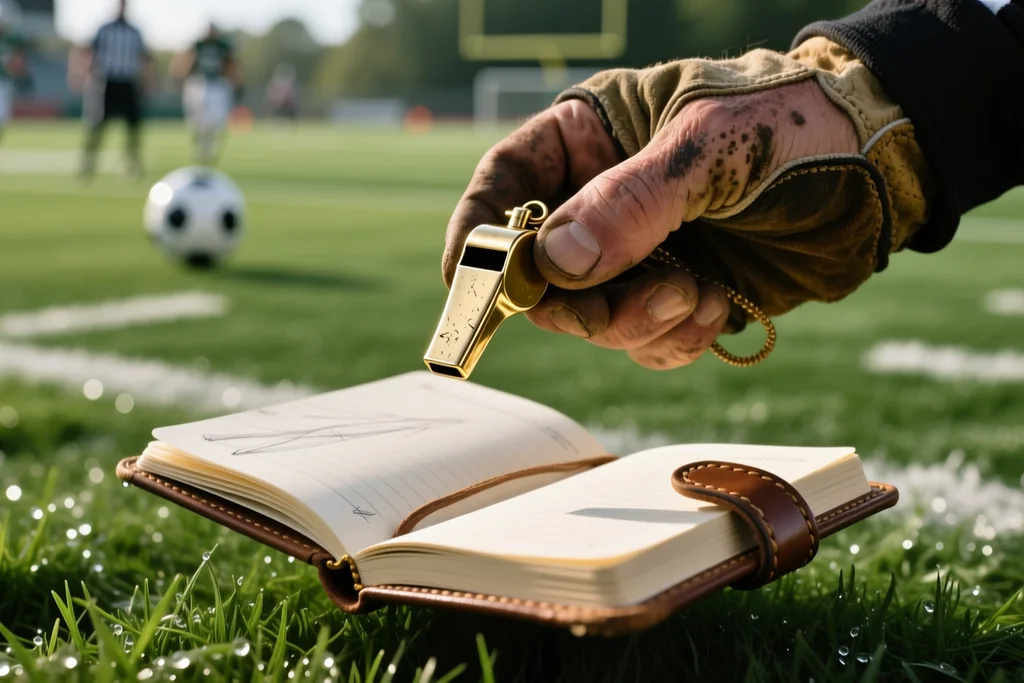
Anthony Taylor refereeing: why finals demand something different
Cup finals and European knockout ties bring a specific pressure: the margin for error is a season's work, the atmosphere is louder, and both teams arrive with a plan that assumes the referee will be cautious. Officials are briefed accordingly, and the threshold for intervention can shift slightly, but the method does not change.
What changes is the preparation. Officials review both teams in detail, including the routines that produce confrontations and the players most likely to be involved in them. That information is used before kick-off, in the conversations and positioning that shape the first twenty minutes.
| Stage | Action | When it is used |
|---|---|---|
| Quiet word | Private instruction to a player | First sign of a pattern |
| Public warning | Message delivered through the captain | Behaviour continues |
| Free kick and lecture | Restart plus a clear explanation | Persistent minor fouling |
| Caution | Yellow card, recorded in the report | Reckless or deliberately disruptive conduct |
| Dismissal | Red card, player leaves the field | Serious offences or a second caution |
The role of the video team in match control
Video review has changed game management in a subtle way. Because a decision can be corrected, referees are sometimes advised to hold a sanction rather than issue it immediately, particularly where a red card offence needs a second look. That has produced awkward moments on the pitch, with players waiting for an outcome, and it has forced officials to develop a new vocabulary for explaining a delay.
The referee still owns the final call, which is why the protocol requires the on-field decision to be the starting point of every check. An official with good match control tends to have more decisions survive review, simply because the information they gathered in the moment was sound.
Why this skill is hard to teach
Law knowledge can be learned, fitness can be built, and procedure can be drilled. Reading a match is different. It requires recognising a pattern of behaviour before it produces an incident, and then choosing the intervention that costs least and achieves most. That judgement comes from years of matches across every level of the game.
The structures behind it are described in Law 12 and the card ladder, and the authority the referee draws on is set out in Law 5. For how an official reaches the level where this work is assessed match by match, see the promotion pathway.
How a referee prepares for the atmosphere, not just the teams
Match control begins in the tunnel. Officials are trained to read the temperature before kick-off: the body language of the two captains, the mood of a bench that has been under pressure, the noise from a full stand. That reading shapes the first conversation, and the first conversation sets the tone for the rest of the match.
Briefing also covers the phases most likely to produce trouble. Derby fixtures, relegation six-pointers and knockout ties have their own patterns: more contact in the opening ten minutes, more crowding around decisions, and more pressure on the fourth official. Knowing that in advance is the difference between managing an incident and reacting to one.
Game management is the part of refereeing that leaves no trace. The cards that were never shown and the confrontations that never happened are invisible in a match report, and they are the reason the fixture was remembered as a good one.
Read next

Premier League Referee Appointments Explained
A referee is appointed to a match like a player is picked for a squad: form, fitness, geography and workload all count.
2026-09-26
Michael Oliver Referee Profile: Positioning as a Superpower
Watch a referee who is never in the way of the camera angle, and you are watching positioning. It is the most underrated skill in officiating.
2026-09-16
Craig Pawson Referee Style: The Quiet Art of Control
The best controlled matches are the ones nobody talks about afterwards. That is not luck, it is method.
2026-08-22