
Law 12 Fouls and Misconduct: When the Cards Come Out
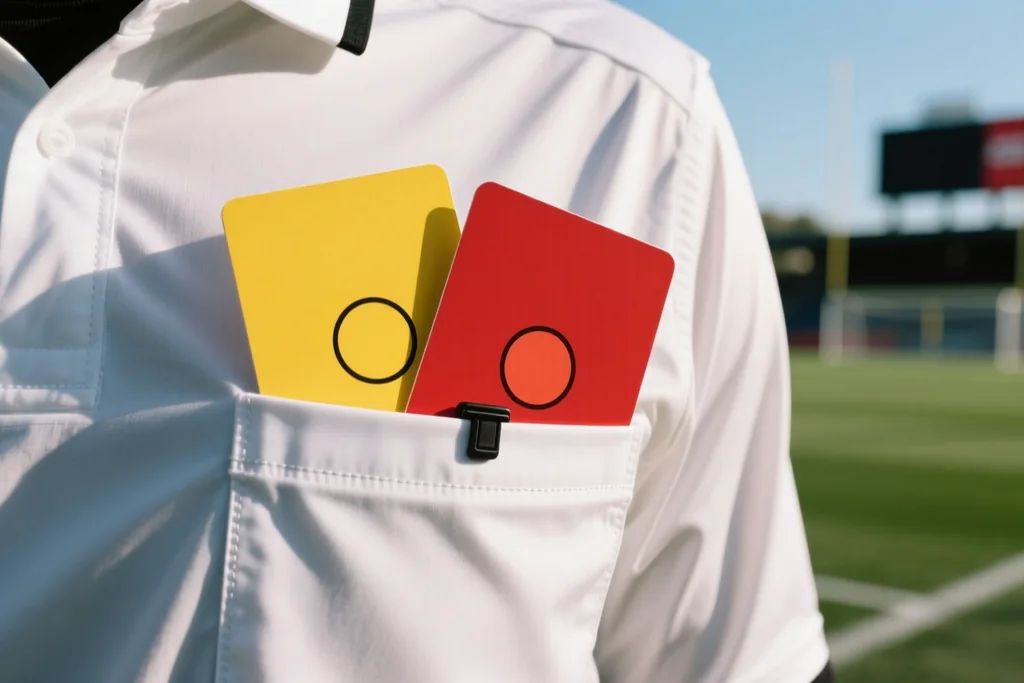
Law 12 fouls and misconduct is the busiest clause in the lawbook, and it rests on one simple idea: not every illegal challenge deserves the same punishment. The law sorts contact into three levels of risk — careless, reckless and excessive — and attaches a different sanction to each. Careless contact is a free kick, reckless contact is a free kick and a yellow card, and excessive force is where the red cards and penalty-area decisions begin.
The definitions matter more than the punishments. Careless means a lack of attention or consideration when challenging an opponent. Reckless means the player acted with disregard for the danger to an opponent, which usually shows up as a late arrival, a raised stud or a challenge from behind. Excessive force means the challenge endangers the safety of an opponent, and it does not require contact to be violent to qualify.
The direct free kick offences
A direct free kick is awarded when a player commits one of the listed offences against an opponent in a manner the referee considers careless, reckless or using excessive force. The list is short and specific, which is why most disputes are about the manner of the challenge rather than the category of offence.
- Charging, jumping at, kicking or attempting to kick an opponent.
- Pushing, striking or attempting to strike, including with the head or an elbow.
- Challenging an opponent for the ball in a way that makes contact before the ball.
- Tripping or attempting to trip, including a sliding challenge that takes the player first.
- Holding, impeding with contact, biting, spitting or throwing an object at someone.
- Handling the ball to gain control, which includes deliberately blocking a shot with the arm.
The indirect offences
Some offences are punished with an indirect free kick, meaning the ball must touch another player before a goal can be scored. They are not contact offences: dangerous play such as a high boot near an opponent's head, impeding an opponent without contact, and goalkeeper offences such as handling a deliberate back pass or handling the ball after releasing it all sit here.

Yellow card rules: when a caution is the answer
Cautions are not reserved for bad challenges. The law lists a set of behaviours that undermine the match itself, from dissent to delaying a restart, and a referee has no discretion to leave them unpunished once the behaviour is clear. Persistent offences work the same way: the third or fourth cynical foul by the same player becomes a caution even if none of them was reckless on its own.
| Sanction | Typical offences | How it is recorded |
|---|---|---|
| Free kick only | Careless challenge, minor contact | Whistle and restart |
| Caution | Reckless challenge, dissent, delaying restart, persistent offences, excessive celebration | Yellow card, name in the report |
| Dismissal | Serious foul play, violent conduct, spitting, denying a goalscoring opportunity, offensive language | Red card, player leaves the field |
| Second caution | Any second cautionable offence in the same match | Yellow followed by red |
| Corner kick | Goalkeeper exceeding the eight-second limit | Restart from the corner |
Denying a goalscoring opportunity: the red card rules
The most argued category is the denial of an obvious goalscoring opportunity, whether by a foul or by deliberate handball on the line. Four questions decide it: the distance between the offence and the goal, the general direction of play, the likelihood of keeping or gaining control of the ball, and the location and number of defenders. A foul forty yards from goal with two covering defenders is not the same offence as a trip on the edge of the six-yard box.
Referees also have to decide whether the challenge was a genuine attempt to play the ball inside the penalty area, which changes a red card into a caution for certain offences. That exception exists so that a mistimed tackle does not end a career in a cup final, and it does not apply to holding, pulling or a deliberate handball.
How cards shape the rest of the match
A booking changes a player's behaviour for the remaining hour. Coaches substitute cautioned defenders to protect them, referees adjust their tolerance for a second borderline challenge, and the team with ten players reorganises. That is why the threshold for a caution is examined so closely: the sanction does not just punish an act, it rewrites the match.
The card system interacts directly with the review process. A direct red card is a reviewable decision, and since the 2026/27 edition so is a dismissal that followed a second caution the video team judged to be clearly wrong; a booking that stands on its own is not. Our guide to what VAR can and cannot review sets that out, and the way decisions are communicated afterwards is covered in the high bar debate.
Deception and the caution nobody expects
Attempting to deceive the referee is itself an offence. A dive, an exaggerated fall or a faked injury will be cautioned for unsporting behaviour, and if play is stopped for the deception the opponents restart with a free kick. What referees are told not to do is caution a player simply because there was contact and they went down.
The test is whether the player attempted to create a false impression. A forward who is clipped and falls awkwardly has committed no offence. A forward who throws himself to the ground with no contact, or who holds a face that was never touched, has. Referees watch the reaction as closely as the contact, because the reaction is usually the only evidence available.
Read the three definitions once and the argument on the terraces becomes a technical question with a right answer. Careless, reckless and excessive force are the vocabulary of every conference between a captain and a referee.
Read next

Law 1: The Field of Play, Measured
Every match starts with a rectangle. Law 1 sets its dimensions, its lines and the marks that decide penalties and goal kicks.
2026-10-18
Law 2: The Ball, and What Makes It Legal
Circumference, weight, pressure and the dropped ball after a burst: Law 2 in the numbers the officials actually use.
2026-10-18
Law 3: How Many Players and How Many Subs
Eleven to start, seven to continue, five substitutions from three opportunities: the numbers and procedures in Law 3.
2026-10-18