
Law 1: The Field of Play, Measured
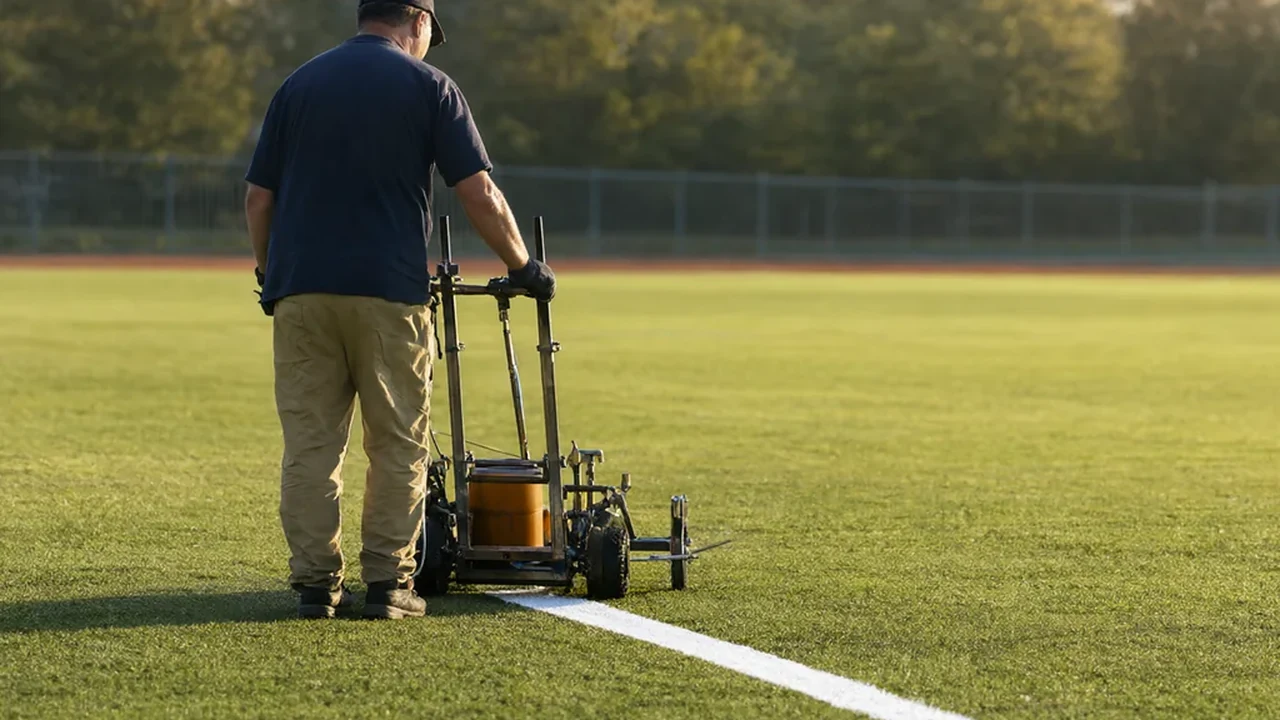
Law 1 is where every match begins, because a pitch that is marked badly creates problems no referee can solve later. The law fixes the shape of the field, the width of the lines and the distance between the marks that decide penalties, goal kicks and corner kicks. Supporters rarely read it; referees check it before they check anything else.
The whole of Law 1 fits on a couple of pages of the lawbook, but the details carry weight. Move the edge of a penalty area by a metre and the geometry of every defensive wall changes with it.
What Law 1 requires of the surface
The field of play must be rectangular and marked with continuous lines that are not dangerous. The two longer boundary lines are touchlines, the two shorter ones are goal lines. A halfway line joins the midpoints of the touchlines, and the centre mark sits at its midpoint with a circle of 9.15 m drawn around it.
The surface must be wholly natural, or wholly artificial where competition rules permit, or a hybrid of natural and artificial materials. Artificial surfaces must be green. In international matches and international club competitions they must meet the FIFA Quality Programme for Football Turf unless special dispensation is given.
The dimensions that define a pitch
The touchline must always be longer than the goal line. Inside that rule, competitions set their own measurements within the ranges below. International matches use the tighter band, which is why a European night can look narrower than a lower-league ground with a wide, long surface.
| Measurement | National matches | International matches |
|---|---|---|
| Touchline length | 90-120 m | 100-110 m |
| Goal line length | 45-90 m | 64-75 m |
| Width of any line | maximum 12 cm | maximum 12 cm |
| Goal: inside of posts | 7.32 m | 7.32 m |
| Goal: ground to crossbar | 2.44 m | 2.44 m |
| Penalty area depth | 16.5 m | 16.5 m |
| Goal area depth | 5.5 m | 5.5 m |
| Penalty mark from goal line | 11 m | 11 m |
| Centre circle radius | 9.15 m | 9.15 m |
| Corner arc radius | 1 m | 1 m |
Measurements are taken from the outside of the lines, because the lines belong to the areas they enclose. That one sentence settles a surprising number of arguments: a ball touching the line is still in play, and a foul on the line is inside the area.
Markings, and why the line matters
All lines must be the same width and no line may be wider than 12 cm. The goal lines must be the same width as the goalposts and crossbar. Only the lines described in Law 1 may be marked; on artificial surfaces other lines are allowed if they are a different colour and clearly distinguishable.
A player who makes unauthorised marks on the field is cautioned for unsporting behaviour. If the referee notices it during play, the caution is issued when the ball next goes out of play, which shows how the laws prefer a clean restart to a theatrical stoppage.
The goal area, the penalty area and the marks inside them
Two lines are drawn at right angles to the goal line, 5.5 m from the inside of each post. They extend 5.5 m into the field and are joined by a line parallel to the goal line. That box is the goal area, still called the six-yard box by everyone who watches English football.
The penalty area uses the same construction at 16.5 m. Inside it the penalty mark sits 11 m from the midpoint between the posts, measured from the centre of the mark to the back edge of the goal line. The arc outside the area is part of a circle with a 9.15 m radius from the centre of the penalty mark, which is exactly why a defensive wall stands where it does.
Goals, flagposts and the technical area
- Goal frame: white posts and crossbar, the same width and depth, no more than 12 cm, placed on the centre of each goal line.
- Flagposts: at least 1.5 m high with a non-pointed top at each corner, and optionally at each end of the halfway line at least 1 m outside the touchline.
- Corner area: a quarter circle of 1 m radius drawn inside the field at each corner flagpost.
- Technical area: extends 1 m either side of the seated area and up to 1 m from the touchline, with one person at a time allowed to give tactical instructions.
- Additional marks: optional marks 9.15 m from the corner arc at right angles to the goal lines and touchlines, keeping defenders back at a corner.
Advertising is part of the same law, which surprises people who assume it is purely commercial. No form of commercial advertising is permitted on the field of play, on the ground inside the goal nets, in the technical area or within 1 m of the boundary lines while the teams are on the pitch. Nothing may be attached to the goals, nets, flagposts or flags, and upright advertising must stand at least 1 m from the touchline.
If the crossbar is displaced or broken, play stops until it is repaired or replaced in position. If it cannot be repaired, the match is abandoned. A rope or any flexible material is never an acceptable substitute, and goals must be firmly secured to the ground.
Nets may be attached to the goals and to the ground behind them, but they must be properly supported and must not interfere with the goalkeeper. Goal line technology, where a competition uses it, applies only to the goal line and only to the question of whether a goal has been scored.
What a referee does when the field is imperfect
At the lower levels of the game a missing corner flag or grey goalposts are a report, not a cancellation. The practical guidance is to let the match be played with the agreement of both teams and to submit a report to the authorities afterwards. Law 1 sets the standard; the referee judges how much of it the ground can deliver on the day.
For the rest of the book, start with the 17 Laws explained in plain English, or go straight to the referee powers and duties that turn these measurements into decisions.
Read next

Law 2: The Ball, and What Makes It Legal
Circumference, weight, pressure and the dropped ball after a burst: Law 2 in the numbers the officials actually use.
2026-10-18
Law 3: How Many Players and How Many Subs
Eleven to start, seven to continue, five substitutions from three opportunities: the numbers and procedures in Law 3.
2026-10-18
Law 4: Players' Equipment and What Is Banned
Five compulsory items, a total ban on jewellery and strict rules on colours: what Law 4 allows a player to wear.
2026-10-18