
Law 4: Players' Equipment and What Is Banned
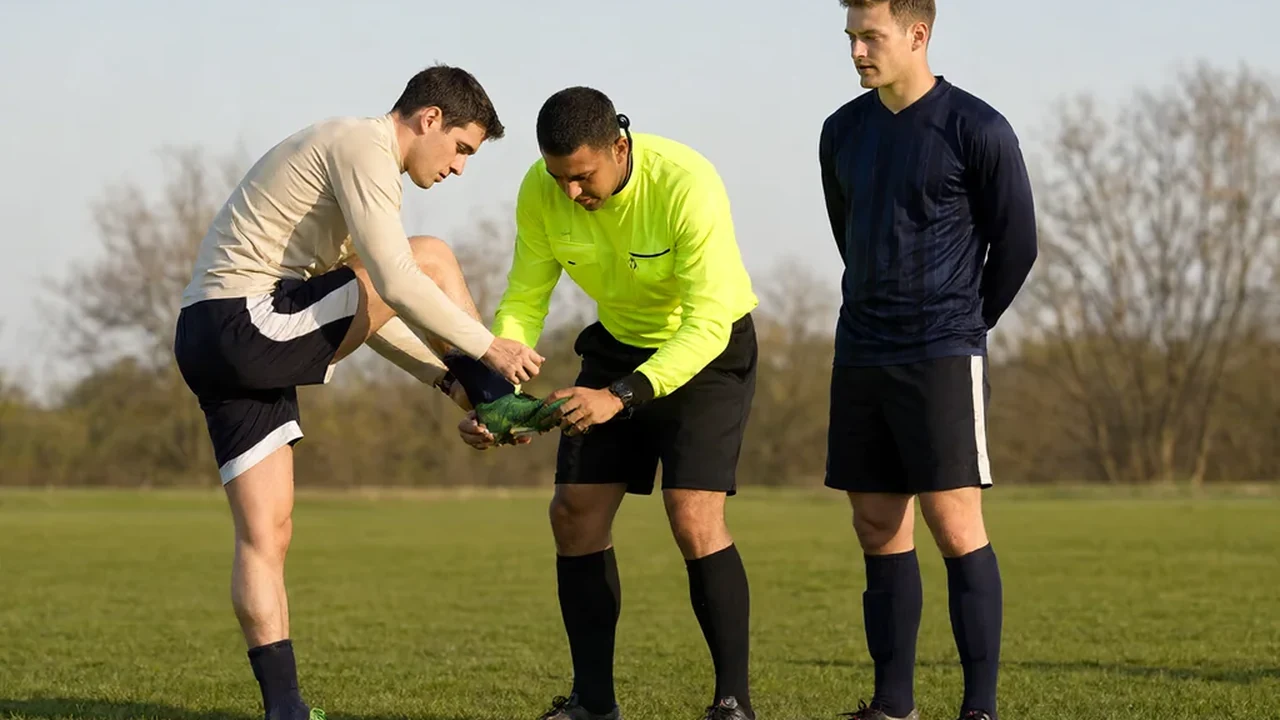
Law 4 is the law players argue with most, because it touches what they put on their body. The list of compulsory equipment is short, the list of forbidden items is longer, and the referee has to enforce both without turning a warm-up into an inspection queue.
The purpose is safety first and identity second. A player must be protected, and the two teams plus the officials must be distinguishable at a glance from thirty metres away.
The five compulsory items
A player's compulsory equipment is a shirt with sleeves, shorts, socks, shinguards and footwear. Each item has a condition attached. Tape or any material applied to the sock must be the same colour as the part of the sock it covers. Shinguards must be made of suitable material, of an appropriate size to give reasonable protection, and covered by the socks.
Responsibility for the size and suitability of shinguards sits with the player, not the referee. That is a deliberate allocation: officials check that shinguards are worn and covered, but they are not expected to test whether a piece of plastic would stop a tackle.
Substitutes are inspected before they enter the field, not when they arrive at the ground, and the captain must wear the armband issued or authorised by the competition. A plain single-colour band carrying only the word captain, the letter C or a translation is also acceptable.
| Item | Requirement |
|---|---|
| Shirt | Must have sleeves; undershirt must match the sleeve colour |
| Shorts | Undershorts and tights must match the main shorts colour |
| Socks | Tape and external material must match the covered part |
| Shinguards | Suitable material, appropriate size, covered by socks |
| Footwear | Compulsory; a boot lost accidentally must be replaced by the next stoppage |
| Jewellery | All items forbidden, including rings, necklaces and earrings |
| Captain | Armband issued or authorised by the competition, or a single-colour band |
Jewellery, tape and the safety rule
A player must not wear anything dangerous, and all items of jewellery are forbidden: necklaces, rings, bracelets, earrings, leather bands, rubber bands and anything similar. They must be removed. Using tape to cover jewellery is not permitted, which ended the era of the taped wedding ring.
Accessories are allowed if they are not dangerous and are safely and securely covered, but dangerous items must be removed rather than taped. That difference matters in practice: a soft wristband can be covered, a metal ring cannot.
Colours, undershirts and goalkeepers
The two teams must wear colours that distinguish them from each other and from the match officials. Each goalkeeper must wear colours that distinguish them from the other players and the officials. If the two goalkeepers have the same colour shirt and neither has an alternative, the referee allows the match to be played.
Undershirts must be a single colour matching the main colour of the shirt sleeve, or a pattern that exactly replicates the sleeve. Undershorts and tights must match the main colour of the shorts or their lowest part, and players of the same team must wear the same colour. These rules exist for television and for the assistant referee's peripheral vision, not for aesthetics.
Head covers, technology and communication
Non-dangerous protective equipment is permitted: gloves, headgear, facemasks, soft padded knee and arm protectors, goalkeepers' caps and sports spectacles. Goalkeepers may wear tracksuit bottoms. Head covers must be black or the same main colour as the shirt, must not be attached to the shirt and must have no protruding elements.
Gloves are optional for everyone, including goalkeepers. A keeper in bare hands is unusual but entirely legal, and a referee has no reason to comment on it. The same logic applies to a captain who prefers a plain band to the competition's branded one, as long as the band is a single colour.
Players may not wear or use any form of electronic or communication equipment, apart from approved electronic performance and tracking systems. Team officials may use small handheld devices for welfare, safety or coaching, and an official who uses unauthorised equipment or behaves inappropriately as a result is sent off.
Slogans and statements on kit
Equipment must not carry political, religious or personal slogans, statements or images, and players must not reveal undergarments showing them. The law goes further than most people expect: messages relating to any person living or dead, any political organisation, any government department or any discriminatory organisation are not permitted.
Permitted messages are usually confined to the shirt front or the captain's armband, and competition rules may restrict size, number and position. Disputes are best settled before kick-off, not in the tunnel.
What happens when a player is improperly equipped
- Before the match: the player is inspected and must correct the equipment before playing.
- During the match: the player is instructed to leave the field at the next stoppage to correct it.
- Re-entry: the equipment is checked by a match official and the player returns only with the referee's permission.
- Without permission: the player is cautioned, and play restarts with an indirect free kick unless there was interference, which makes it a direct free kick or penalty.
One exception is worth remembering: a player who accidentally loses a boot or shinguard must replace it as soon as possible and no later than the next stoppage, but a goal scored before that happens still counts. The law punishes the delay, not the bare foot.
For how these offences interact with cards, read the Law 12 guide, and for the season's wider changes see what changed in the 2026-27 laws.
Read next
Law 1: The Field of Play, Measured
Every match starts with a rectangle. Law 1 sets its dimensions, its lines and the marks that decide penalties and goal kicks.
2026-10-18
Law 2: The Ball, and What Makes It Legal
Circumference, weight, pressure and the dropped ball after a burst: Law 2 in the numbers the officials actually use.
2026-10-18
Law 3: How Many Players and How Many Subs
Eleven to start, seven to continue, five substitutions from three opportunities: the numbers and procedures in Law 3.
2026-10-18