
Inside the VAR Room: Who Sits Where and What They Say
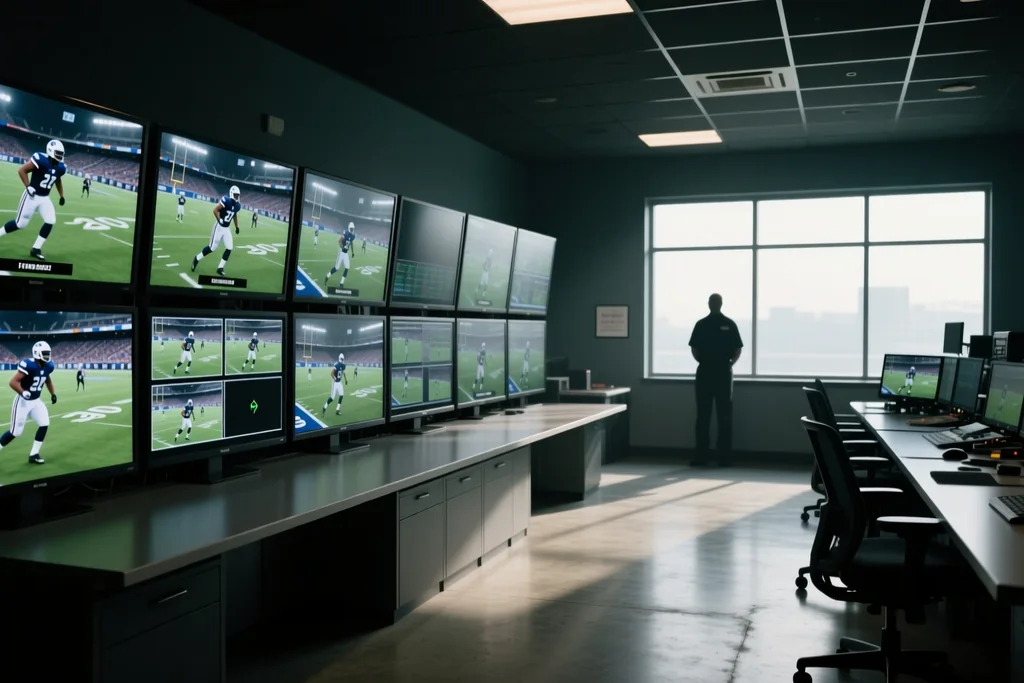
Inside the VAR room there is more than one person, and the video assistant referee is only the most senior presence among them. Television coverage has made the darkened room familiar — a wall of screens and a handful of people in headsets — without ever explaining who each of them is or what they do. Understanding the room explains most of the delay that supporters experience without understanding.
The working environment is deliberately isolated. VAR hubs are built without windows for the matches they cover, staffed by officials who are not involved in the on-field appointment, and equipped with feeds from every broadcast camera plus the extra angles a competition installs. Separation from the stadium is a feature: nobody in the room should be reacting to the noise of a crowd.
The seats in the VAR room
Roles differ slightly between competitions, but the standard setup is consistent. Alongside the video assistant referee sit an assistant VAR, one or more replay operators, and a technician responsible for the tracking and goal-line systems. A supervisor may also monitor the room for procedural compliance.
- Video assistant referee: leads the review, speaks to the referee, makes the recommendation.
- Assistant VAR: watches a separate feed and provides a second opinion on the same incident.
- Replay operator: cuts the angles, slows the footage and prepares the sequence the referee will see.
- Technology operator: runs the offside and goal-line systems and confirms the data.
- Supervisor: monitors procedure and logs the review for the competition's quality process.
What a normal minute looks like
Most of the room's work is invisible. When a goal is scored, the team is already checking the build-up while the players celebrate. The replay operator is running through camera angles in a fixed order, the assistant VAR is watching the same passage from a different view, and the video assistant referee is deciding whether anything meets the threshold for intervention.
Why the room stays silent
The audio channel between the referee and the video assistant referee is closed, which means the conversation is not heard by the crowd, the commentators or the benches. That silence protects the decision-making process from outside pressure, but it also feeds suspicion, because supporters are asked to accept an outcome they could not hear being reached.
Competitions have responded by releasing selected audio after matches, and by allowing referees to announce the result of a review over the public address system. Neither changes the protocol, but both convert a private process into a narrated one, which is why they have been widely welcomed.
| Seat | Main task | Under pressure when |
|---|---|---|
| Video assistant referee | Decide whether to intervene | Incident is genuine judgement |
| Assistant VAR | Second opinion on a second feed | The two feeds disagree |
| Replay operator | Prepare the angles | The best angle is unavailable |
| Technology operator | Offside and goal-line data | Tracking data is unclear |
| Supervisor | Procedure and logging | A review does not follow protocol |
How mistakes happen in a well-run room
The most documented failures have not been failures of equipment. They have been failures of communication: a check completed before a decision was confirmed, a sentence spoken after the point where it could change anything, or an assumption about what the referee intended. In a room where several people speak at once, the order of information matters as much as the information itself.
That is why the protocol insists the referee remains the decision-maker and why procedures were tightened after high-profile errors. Reviews are recorded in full, and the recordings are used in training, which means a mistake in September becomes a teaching clip by November.
What the room cannot do
It cannot review a yellow card considered on its own, a throw-in awarded to the wrong team, or a foul outside the penalty area that did not lead to a goal, although a dismissal that followed a clearly wrong second caution is now inside the protocol. It cannot invent an offence nobody noticed unless the incident is serious enough to count as a missed incident. And it cannot overrule the referee's judgement simply because the replay looks worse on television.
The rules that bind the room are set out in the four reviewable categories, and the sequence the team follows is described in the VAR protocol step by step. The threshold that decides whether the room speaks at all is covered in the clear and obvious error test.
Who is in the VAR room: who staffs it across a season
Video officials come from the same pool as the referees on the pitch. A member of the Select Group may take charge of a match on Saturday and sit as video assistant referee on Sunday, and the same officials rotate between the two roles through the season. That rotation is deliberate: it keeps interpretation aligned between the people making decisions and the people reviewing them.
Workload is managed centrally. Officials are tracked across matches, travel and consecutive appointments, and a referee who has worked a demanding fixture is far less likely to be given a long VAR shift the following day. Physical preparation matters in the room as well, because a two-hour shift in front of a bank of screens is a genuine test of concentration.
Training runs the same way as on-field training: law updates, video libraries of past incidents, and calibration sessions where officials mark the same clips and compare their answers. The aim is a shared standard, so that a handball in August is judged the same way as a handball in April.
Once the seats are named and the process is clear, the VAR room stops being a black box. It is a small operations centre doing a narrow job under a fixed protocol, and its most common outcome is to say nothing at all.
Read next
VAR Rules Explained: What Can and Cannot Be Reviewed
VAR is not a second referee and it never re-referees a match. Four categories of decision are reviewable, and the list is shorter than most fans assume.
2026-09-25
The Clear and Obvious Error Test: Why VAR Stays Silent
Two words in the protocol do most of the work: clear and obvious. They are also the reason a decision you hate can survive a video review.
2026-09-14
The VAR Protocol, Step by Step: Check, Review, Call
Every review follows the same sequence, and it starts before anyone in the stadium knows a decision is being examined at all.
2026-09-06