
Law 11 Offside in Full: Position, Moment and Active Play
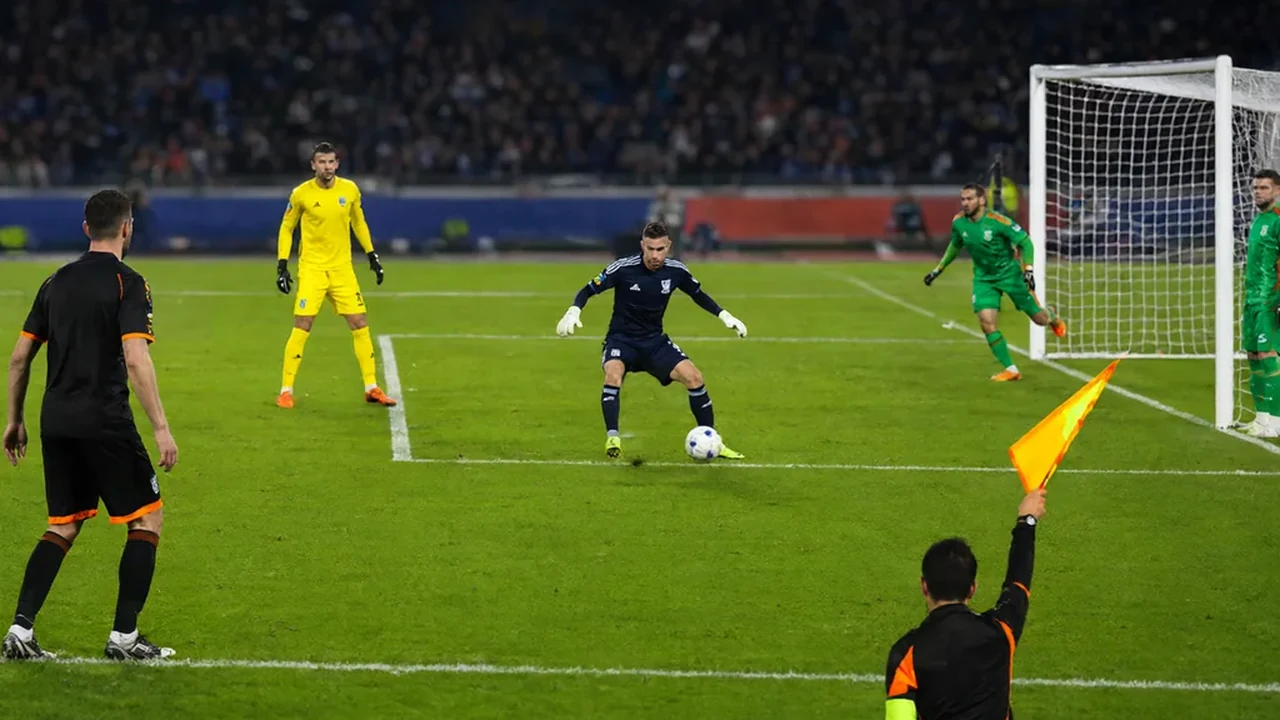
Offside is the law that produces the most argument and the fewest genuine surprises. Once you separate the two questions the law asks, most of the noise disappears: was the player in an offside position when the ball was played, and did that player then become involved in active play? Being in an offside position is not an offence. Only the second question produces a free kick.
Law 11 is built on that split, and the 2026/27 text is the most precise version yet, down to the point on the arm where the body ends for offside purposes. This is the whole law in the order a referee applies it.
Condition one: in the opponents' half
A player can only be in an offside position in the opponents' half. The law is explicit that the halfway line itself is excluded, so a player standing on the line with part of the body over it is not in the opponents' half for this purpose. Any part of the head, body or feet in the opponents' half satisfies the first condition, and a single heel is enough.
Condition two: nearer the goal line than the ball and the second-last opponent
The second condition is comparative. Any part of the head, body or feet must be nearer to the opponents' goal line than both the ball and the second-last opponent. Both parts matter: a player level with the second-last opponent is onside, and a player who is behind the ball is onside however deep they are, even if only the goalkeeper is between them and the goal.
The hands and arms of all players, goalkeepers included, are not considered. The law settles the boundary: for offside purposes the upper boundary of the arm is in line with the bottom of the armpit. That is why the tightest decisions in the modern game are measured from a shoulder, a knee or a toe, and never from a forearm.
- Level with the second-last opponent: onside.
- Level with the last two opponents: onside.
- Behind the ball: onside, wherever the defenders are.
- Arm or hand beyond the last defender: irrelevant, unless the rest of the body is also beyond.
- On the halfway line: not in the opponents' half, so not in an offside position.
The moment that freezes the picture
Position is judged at the moment the ball is played or touched by a team-mate, not when the player receives it. The first point of contact of that play or touch is the reference. There is one exception: when the ball is thrown by the goalkeeper, the last point of contact is used instead.
That timing explains the most common misunderstanding in the stands. A forward who is onside at the pass and runs beyond the defence to collect the ball has committed no offence, because the picture was taken early. A forward who is offside at the pass and then walks back into an onside position is still liable for the original position if they become involved in active play.
The three ways to become involved in active play
A player in an offside position is penalised only on becoming involved in active play, and the law lists the routes. The first is interfering with play by playing or touching a ball passed or touched by a team-mate. The second is interfering with an opponent, and the law breaks that down: preventing an opponent from playing or being able to play the ball by clearly obstructing their line of vision, challenging an opponent for the ball, clearly attempting to play a ball which is close when that action impacts on an opponent, or making an obvious action which clearly impacts on the ability of an opponent to play the ball.
The third is gaining an advantage by playing the ball or interfering with an opponent when the ball has rebounded or been deflected off the goalpost, crossbar or an opponent, or has been deliberately saved by any opponent. A save is defined narrowly: a player stops, or attempts to stop, a ball that is going into or very close to the goal, with any part of the body except the hands or arms, unless the player is the goalkeeper inside the penalty area.
| Question | What the law asks | If the answer is yes |
|---|---|---|
| Where was the player at the pass? | Head, body or feet in the opponents' half, excluding the halfway line | First condition met |
| Was the player beyond the ball and the second-last opponent? | Any part of head, body or feet nearer the goal line, arms excluded | In an offside position |
| Did the player become involved in active play? | Interfering with play, interfering with an opponent, or gaining an advantage | Offside offence |
| Did the ball come from a goal kick, throw-in or corner? | Direct receipt from one of the three exempt restarts | No offence |
| Did an opponent deliberately play the ball? | Control with the possibility of passing, gaining possession or clearing | No offence, unless it was a deliberate save |
Deliberate play by an opponent
A player in an offside position who receives the ball from an opponent who deliberately played it, including by deliberate handball, has not gained an advantage, unless the opponent's action was a deliberate save. Deliberate play means control of the ball with the possibility of passing to a team-mate, gaining possession, or clearing it. If the pass, the attempt to gain possession or the clearance is inaccurate or unsuccessful, that does not undo the fact that the player deliberately played the ball.
The law also lists what a referee should look at when deciding whether a player had that control: whether the ball travelled from distance and the player had a clear view of it, whether the ball was moving quickly, whether its direction was unexpected, whether the player had time to coordinate the body movement rather than stretching or jumping instinctively, and whether the ball was on the ground, which is easier to play than a ball in the air.
Lines, technology and the assistant referee
The offence is punished with an indirect free kick where it occurred, including when the offence is in the player's own half after a run back. In practice the decision belongs to the assistant referee, who stays in line with the second-last opponent, the ball or the halfway line, whichever is nearer to the goal line being defended. The 2026/27 laws allow competitions to use technology to help with offside decisions, including semi-automated offside technology, which was first used at a World Cup in Qatar in 2022. The technology moves the line, not the law: the armpit boundary, the moment of the pass and the active play tests are unchanged.
The full set of attacking offences, including handball in the build-up, is covered in the offside rule explained. For how the review process handles an offside line that goes wrong, see the referee's powers and duties, and for the other sixteen laws start from the lawbook explained.
Read next
Law 1: The Field of Play, Measured
Every match starts with a rectangle. Law 1 sets its dimensions, its lines and the marks that decide penalties and goal kicks.
2026-10-18
Law 2: The Ball, and What Makes It Legal
Circumference, weight, pressure and the dropped ball after a burst: Law 2 in the numbers the officials actually use.
2026-10-18
Law 3: How Many Players and How Many Subs
Eleven to start, seven to continue, five substitutions from three opportunities: the numbers and procedures in Law 3.
2026-10-18