
Law 10: Goals, Winners and Shoot-Outs
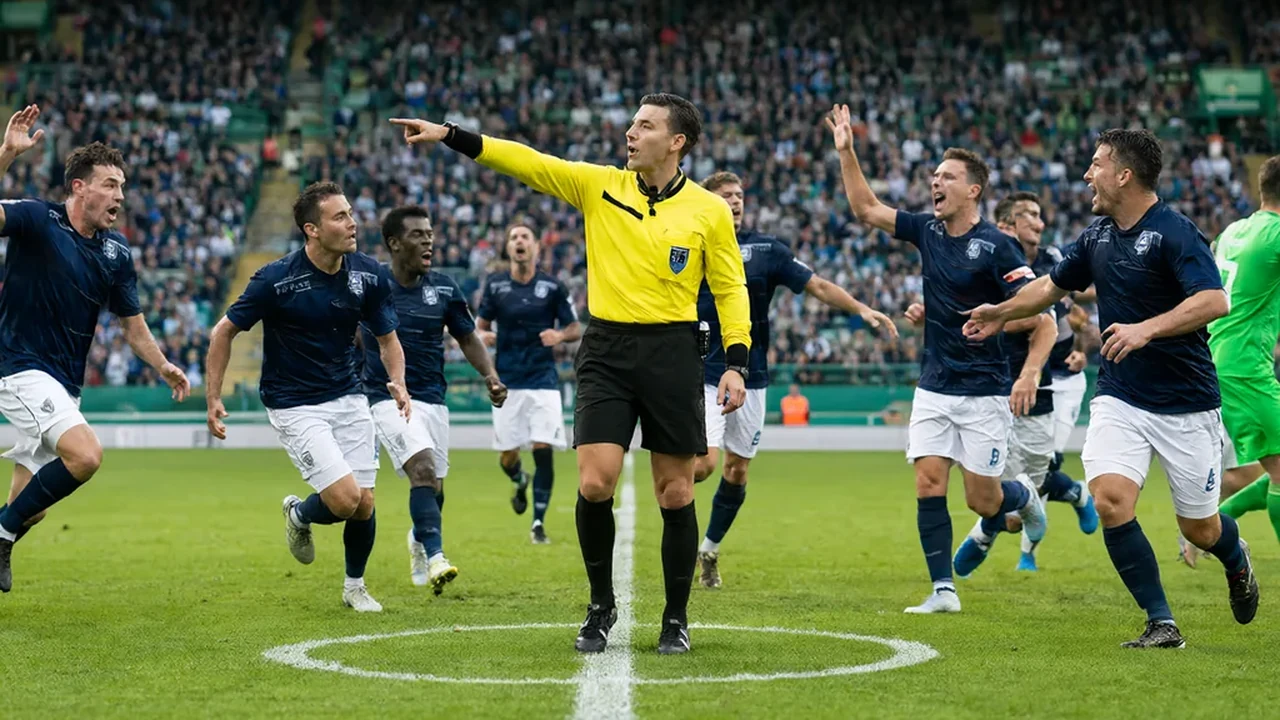
Law 10 decides what the scoreline means. It defines a goal, names the winner, and sets out the only procedures a competition may use to separate teams that finish level. Most of the law is uncontroversial until it reaches the shoot-out, where the detail becomes very precise indeed.
The law also draws a line between the match and what follows it. A shoot-out is taken after the match has ended, and the cautions issued during the match do not carry into it.
What counts as a goal
A goal is scored when the whole of the ball passes over the goal line, between the goalposts and under the crossbar, provided that no offence has been committed by the team scoring it. The whole ball, again: the same standard that governs the touchline governs the goal line.
The proviso is doing real work. A goal is disallowed if the scoring team handled the ball, fouled an opponent or was offside in the build-up, and the fact that the ball crossed the line does not cure the offence.
Goals that are not goals
Two situations deserve their own paragraph. If the goalkeeper throws the ball directly into the opponents' goal, a goal kick is awarded rather than a goal. And if the referee signals a goal before the ball has wholly passed over the line, play restarts with a dropped ball, because the whistle stopped play before the ball crossed.
Both rules follow the same logic: the referee's decision ends the phase of play, and a goal cannot be created after the game has been stopped.
Winner, draw and the permitted tie-breakers
The team scoring the greater number of goals is the winner. If both teams score no goals or an equal number, the match is drawn. That is the default, and it applies in every league match that finishes level.
Where competition rules require a winner after a drawn match or a home-and-away tie, only three procedures are permitted: the away goals rule, two equal periods of extra time not exceeding 15 minutes each, and penalties, meaning a penalty shoot-out. A competition may combine them, which is how a two-legged tie can go to extra time and then to a shoot-out.
The shoot-out before it starts
The referee tosses a coin to decide the goal at which the kicks will be taken, unless ground conditions or safety suggest otherwise, and the goal may only be changed for safety reasons or if it becomes unusable. A second toss decides who takes the first kick.
| Element | Rule |
|---|---|
| Eligible players | On the field or temporarily off it at the end of the match |
| Sent-off players | Not permitted to take part |
| Cards from the match | Not carried forward into the shoot-out |
| Numbers | Teams must have an equal number of players |
| Kicks | Five each, taken alternately |
| Kickers | Each kick by a different player until all eligible players have kicked |
| Early finish | When one team cannot be caught even if it completes its five |
| Level after five | Sudden death, one kick each, until one team leads |
| Goalkeeper | On the field, outside the penalty area, on the goal line |
| Other players | Inside the centre circle, except the kicker and the two goalkeepers |
Who may kick, and who may not
Only players who are on the field or temporarily off it at the end of the match are eligible, with one exception: a substitute for a goalkeeper who is unable to continue. If one team has more players than the other, it must reduce its numbers to match, and the excluded players may not take part, except that one of them may replace a goalkeeper who cannot continue.
A goalkeeper who is replaced during the shoot-out takes no further part and may not take a kick. If the goalkeeper has already taken a kick, the replacement cannot take one until the next round of kicks.
How the kicks are taken
- Alternating: the teams take turns, and the order may change in later sequences.
- Five each: both teams take five kicks unless the result is settled earlier.
- Different kickers: no player takes a second kick until every eligible player has taken one.
- Completion: the kick ends when the ball stops, goes out of play, or play is stopped for an offence.
- No delay: the shoot-out is not delayed for a player who has left the field, and that player's kick is forfeited.
During the shoot-out a player, substitute or team official may still be cautioned or sent off. A goalkeeper who is sent off must be replaced by an eligible player, but any other player who cannot continue may not be replaced. Crucially, the referee must not abandon the match if a team is reduced to fewer than seven players during the kicks.
Where the shoot-out sits in the match
The shoot-out is not part of the match. It takes place after the match has ended, which is why a goal scored in it is not added to a player's match tally and why warnings and cautions from the match are not carried forward. A player cautioned in normal time starts the shoot-out with a clean disciplinary record.
That separation also explains why a player sent off during the match cannot take part: he is no longer a participant, and the shoot-out does not restore him.
Cards during the kicks
The shoot-out is still under the referee's authority. A player, substitute or team official may be cautioned or sent off during the kicks, and a goalkeeper who is sent off must be replaced by an eligible player. A player other than the goalkeeper who cannot continue may not be replaced, which can leave a team with fewer kickers than it started with.
The one thing the referee must not do is abandon the match because a team drops below seven players during the shoot-out. The minimum of seven governs the match; the shoot-out has its own arithmetic.
The shoot-out is the only part of the game where the laws accept that the result may be decided by a procedure rather than by play. For the offences that can interrupt it, see the Law 12 guide, and for the full set of laws, all 17 explained.
Read next
Law 1: The Field of Play, Measured
Every match starts with a rectangle. Law 1 sets its dimensions, its lines and the marks that decide penalties and goal kicks.
2026-10-18
Law 2: The Ball, and What Makes It Legal
Circumference, weight, pressure and the dropped ball after a burst: Law 2 in the numbers the officials actually use.
2026-10-18
Law 3: How Many Players and How Many Subs
Eleven to start, seven to continue, five substitutions from three opportunities: the numbers and procedures in Law 3.
2026-10-18