
Law 15 The Throw-in: Technique, Position and Sanctions
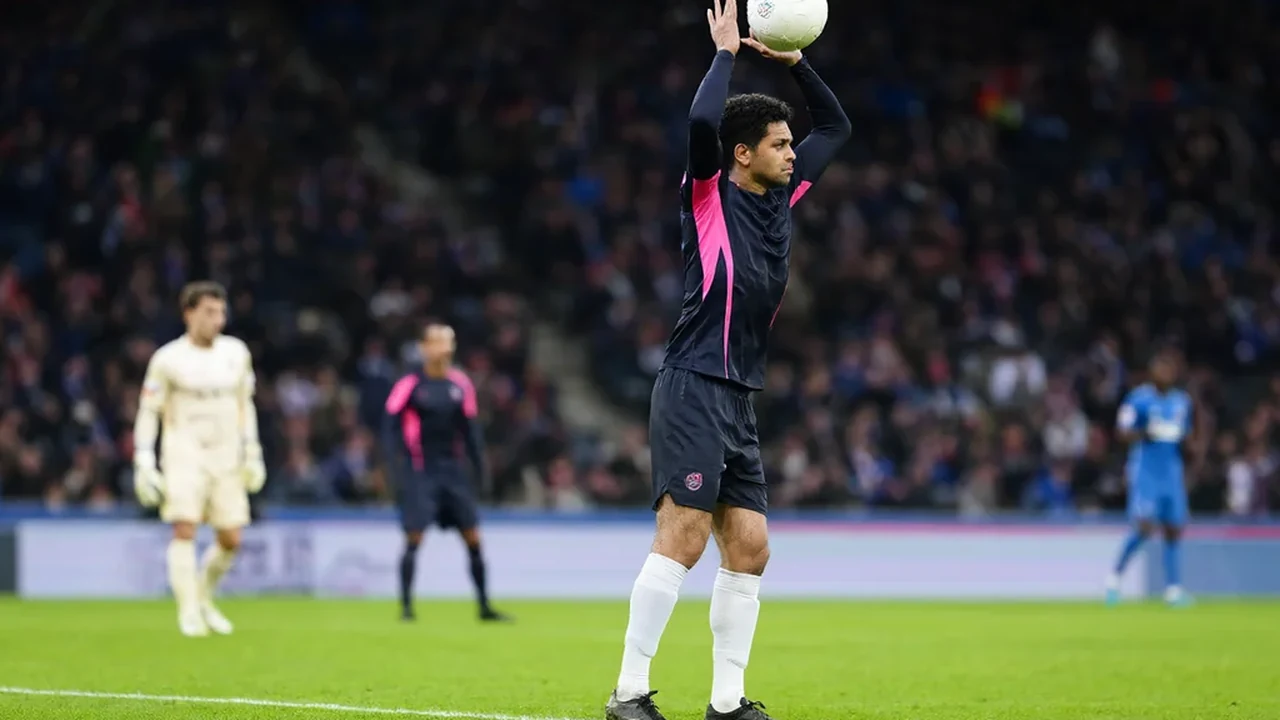
A throw-in looks like the simplest restart in the lawbook and produces more turnovers than any other. Law 15 is a short list of physical requirements, and every one of them is checked at the moment of delivery: the feet, the hands, the point on the touchline, and since the 2026/27 edition, the clock.
The throw-in is awarded to the opponents of the player who last touched the ball when the whole of the ball passes over the touchline, on the ground or in the air. It is also awarded when the referee penalises a player for delaying the taking of a throw-in for their own team. No goal can be scored directly from one: a throw that goes into the opponents' goal produces a goal kick, and a throw that goes into the thrower's own goal produces a corner kick.
The four requirements at the moment of delivery
The law asks for four things at once, and the referee is watching all of them. The thrower must stand facing the field of play, must have part of each foot on the touchline or on the ground outside the touchline, must throw the ball with both hands from behind and over the head, and must do it from the point where the ball left the field of play.
- Facing the field: the chest is open to the pitch, not turned back towards the stand.
- Feet: part of each foot on the line or on the ground behind it, and both feet on the ground.
- Hands: both hands on the ball, delivered from behind and over the head.
- Place: the exact point on the touchline where the ball crossed the line, give or take the referee's tolerance for a metre or so.
Opponents must stand at least 2 m (2 yds) from the point on the touchline where the throw-in is to be taken. That two metres is the smallest protected distance in the laws, and it exists because the alternative was a defender standing nose to nose with the thrower with both feet on the line.
When the ball is in play
The ball is in play when it enters the field of play. If it touches the ground before entering, the throw-in is retaken by the same team from the same position. If the throw-in is not taken correctly, it is retaken by the opposing team. That asymmetry is worth remembering: a ball dropped short onto the grass is a second chance for the thrower, while a foot over the line is a turnover.
The thrower must not touch the ball again until it has touched another player. A second touch produces an indirect free kick, upgraded to a direct free kick, or a penalty kick if it happens inside the thrower's own penalty area, when the second touch is a handball offence. The exception in the penalty area is the goalkeeper: a keeper who handles a second touch in their own area concedes an indirect free kick, not a penalty.
The five-second countdown
The 2026/27 edition added a time limit with a visible count. If a player is unfairly delaying the taking of a throw-in for their team, the referee whistles and signals the start of a five-second countdown, counting it down with a raised hand. If the throw-in has not been taken by the end of those five seconds, it is awarded to the opposing team. The offending player is cautioned only if they then excessively delay the restart after the throw-in has been handed to the opponents.
This is the same mechanism the law now uses at goal kicks, and it is a deliberate shift in how the lawbook handles time-wasting at restarts: the sanction is the loss of the restart itself, not a card. The caution stays in reserve for the player who keeps pushing after the decision has been made.
| Requirement | What the law asks for | If it is not met |
|---|---|---|
| Feet | Part of each foot on the touchline or on the ground outside it | Throw-in to the opponents |
| Delivery | Both hands, from behind and over the head | Throw-in to the opponents |
| Position | From the point where the ball left the field, facing the field of play | Throw-in to the opponents |
| Opponents' distance | At least 2 m (2 yds) from the point of the throw | Caution for unsporting behaviour, indirect free kick if the throw was taken |
| Ball entering the field | In play when it enters the field of play | Retaken by the same team if it touched the ground first |
| Time limit | Taken within five seconds of the referee's countdown | Throw-in to the opponents |
| Second touch | No touch by the thrower until another player touches the ball | Indirect free kick |
Distraction, delay and the goalkeeper
An opponent who unfairly distracts or impedes the thrower, including by moving closer than 2 m to the place where the throw-in is to be taken, is cautioned for unsporting behaviour. If the throw-in has already been taken when the referee stops play for it, the restart is an indirect free kick. For any other offence the throw-in is simply taken by a player of the opposing team, which is the law's default answer to a badly executed restart.
One related offence lives in another law and catches out defenders every season. A goalkeeper may not handle the ball when it has been thrown directly to them by a team-mate. That is a handling offence under Law 12, punished with an indirect free kick from the place where the keeper handled it. The throw-in itself was legal, and the offence happens a second later.
A correctly taken throw can also be used as a weapon rather than a formality. If a player, while correctly taking a throw-in, deliberately throws the ball at an opponent in order to play the ball again, but not carelessly, recklessly or with excessive force, the referee allows play to continue.
What the referee and the assistant are watching
The assistant referee on that touchline owns the decision in practice, because the feet and the point of the throw are both on their side of the pitch. The referee watches the hands and the upper body. A throw that is delivered from the side of the head rather than from behind it, or one foot lifted off the ground at the moment of release, is a turnover that most crowds never see, and it is the reason coaches drill the technique rather than the tactics.
Long throws into the penalty area are treated exactly like a cross, which means the offside law applies normally once the ball has been touched by anyone, and the handling rules apply to everyone except the keeper.
The restart sits alongside the other set pieces in the laws section, and the handling offence it can trigger is set out in Law 12 fouls and misconduct. For how the referee manages the countdown and the warnings around it, see the referee's powers and duties.
Read next
Law 1: The Field of Play, Measured
Every match starts with a rectangle. Law 1 sets its dimensions, its lines and the marks that decide penalties and goal kicks.
2026-10-18
Law 2: The Ball, and What Makes It Legal
Circumference, weight, pressure and the dropped ball after a burst: Law 2 in the numbers the officials actually use.
2026-10-18
Law 3: How Many Players and How Many Subs
Eleven to start, seven to continue, five substitutions from three opportunities: the numbers and procedures in Law 3.
2026-10-18