
Law 7: Duration, Added Time and the Last Kick
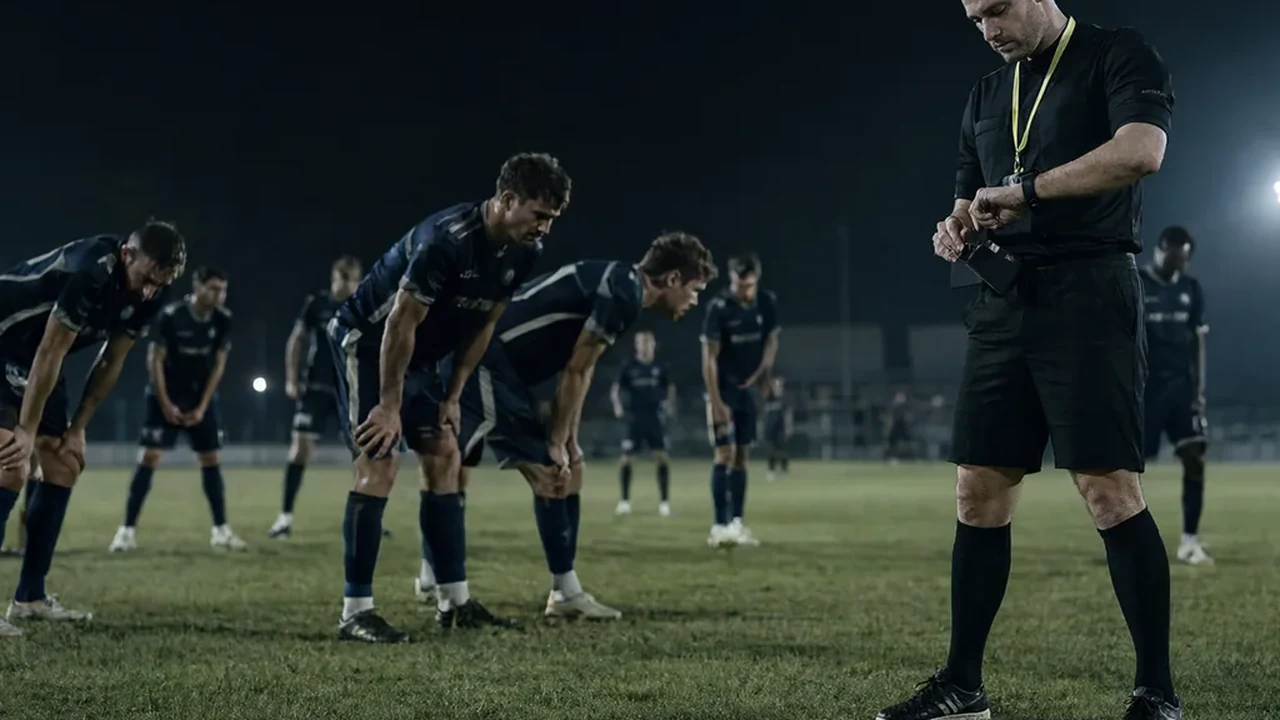
Law 7 looks like the simplest law in the book: forty-five minutes each way. It is also the law that generates the most noise, because it governs the interval, the added time and the penalty that has to be taken after the clock has run out.
The law sets limits rather than exact timings. Competition rules fill in the rest, and the referee applies judgement inside those limits, which is why two matches with identical stoppages can end at different times.
Two halves of 45 minutes
A match lasts two equal halves of 45 minutes. That can only be reduced if the referee and both teams agree before the match and the competition rules allow it. In practice this covers heat, poor light and travel, not a home team protecting a lead.
A half cannot be lengthened by agreement. The only addition is the allowance the referee makes for time lost, and that allowance belongs to the half in which the time was lost.
The half-time interval
Players are entitled to an interval at half-time, not exceeding 15 minutes. Competition rules must state its duration, and it may be altered only with the referee's permission. The interval in extra time may include a short drinks break of no more than one minute.
Drinks breaks during play should not exceed one minute, while cooling breaks are set between ninety seconds and three minutes. Both are competition-level decisions, not something a captain can request in the eightieth minute of a hot afternoon.
What the referee adds on
Allowance is made in each half for all playing time lost in that half. The law lists the causes: substitutions, assessment or removal of injured players, wasting time, disciplinary sanctions, medical stoppages permitted by competition rules, delays for VAR checks and reviews, goal celebrations, and any other significant delay to a restart.
| Period or break | Limit | Who decides |
|---|---|---|
| Each half | 45 minutes | Law, unless reduced before kick-off |
| Half-time interval | Maximum 15 minutes | Competition rules, referee may alter |
| Drinks break | Maximum 1 minute | Competition rules |
| Cooling break | 90 seconds to 3 minutes | Competition rules |
| Extra time, each half | Maximum 15 minutes | Competition rules under Law 10 |
| Penalty at the end of a half | Until the kick is completed | Referee |
The fourth official indicates the minimum additional time decided by the referee at the end of the last minute of each half. The referee may add more, but may not reduce it. A board showing four minutes is a floor, not a cap.
Stoppages that do not stop the clock
The clock in football runs continuously. It is not stopped for an injury, a substitution or a goal celebration; the referee remembers the time and adds it at the end of the half. That is why a match with six substitutions and a long review can run well past fifty minutes without anyone breaking a law.
The referee remains the sole timekeeper even when a fourth official displays the board. The board communicates a decision that has already been made, and the referee stays responsible for the total.
Time lost, time wasted and the law's remedy
There is a case with no card attached. A player who deliberately kicks the ball far over the touchline while the ball is in play has not delayed the restart, because the ball was live when it was kicked, and the laws do not list that as a cautionable offence. The referee's remedy is the allowance for time lost, added at the end of the half.
Wasting time that does attract a sanction is different: holding the ball at a throw-in, delaying a free kick or standing over the ball after the whistle. Those are cautionable, and the time they consume is also added on. The law punishes the act and restores the time, which is why both appear in the same match report.
Timekeeping errors and the second half
The referee must not compensate for a timekeeping error in the first half by changing the length of the second half. If the first half ran two minutes short, the second half is still forty-five minutes plus its own allowance. This is one of the few places where the laws deliberately refuse to correct an error.
The penalty at the end of a half
If a penalty kick has to be taken or retaken, the half is extended until the kick is completed. Completed means the ball has stopped moving, gone out of play, or play has been stopped for an offence. A goal scored directly from that kick counts, and the match ends with the goal, so there is no kick-off afterwards.
The same principle governs a shoot-out, although that is regulated by Law 10 rather than Law 7. At that point the clock is no longer the authority; the completion of the kick is.
Extra time and the interval that follows
Extra time is a competition decision, not an automatic extension. Law 10 permits two equal periods not exceeding 15 minutes each, and Law 7 applies its interval rules to them, including the short drinks break of no more than one minute.
Substitutions behave differently in extra time. A team that has not used its full allocation may use the remainder, and where competition rules permit one additional substitute, that player comes with one additional substitution opportunity. Changes made between full-time and the start of extra time, or at half-time in extra time, do not count as used opportunities.
Abandoned matches
- General rule: an abandoned match is replayed unless competition rules or the organisers decide otherwise.
- Fewer than seven players: if a team is responsible for the abandonment, the match is in principle forfeited by that team.
- Weather and safety: the referee may suspend or abandon the match if the field, its surroundings or the weather make continuing impossible.
- Report: the referee records the reasons for the abandonment and the time it happened.
Law 7 rarely produces a controversial decision on its own. It produces the conditions in which other decisions become controversial, which is why the fourth official's board is watched more closely than any other piece of equipment in the stadium.
For the law that governs the restart after a goal, read the 17 Laws in plain English. For the offence that wastes the most time, see the eight-second goalkeeper law.
Read next
Law 1: The Field of Play, Measured
Every match starts with a rectangle. Law 1 sets its dimensions, its lines and the marks that decide penalties and goal kicks.
2026-10-18
Law 2: The Ball, and What Makes It Legal
Circumference, weight, pressure and the dropped ball after a burst: Law 2 in the numbers the officials actually use.
2026-10-18
Law 3: How Many Players and How Many Subs
Eleven to start, seven to continue, five substitutions from three opportunities: the numbers and procedures in Law 3.
2026-10-18