
Law 8: Kick-Offs and Dropped Balls
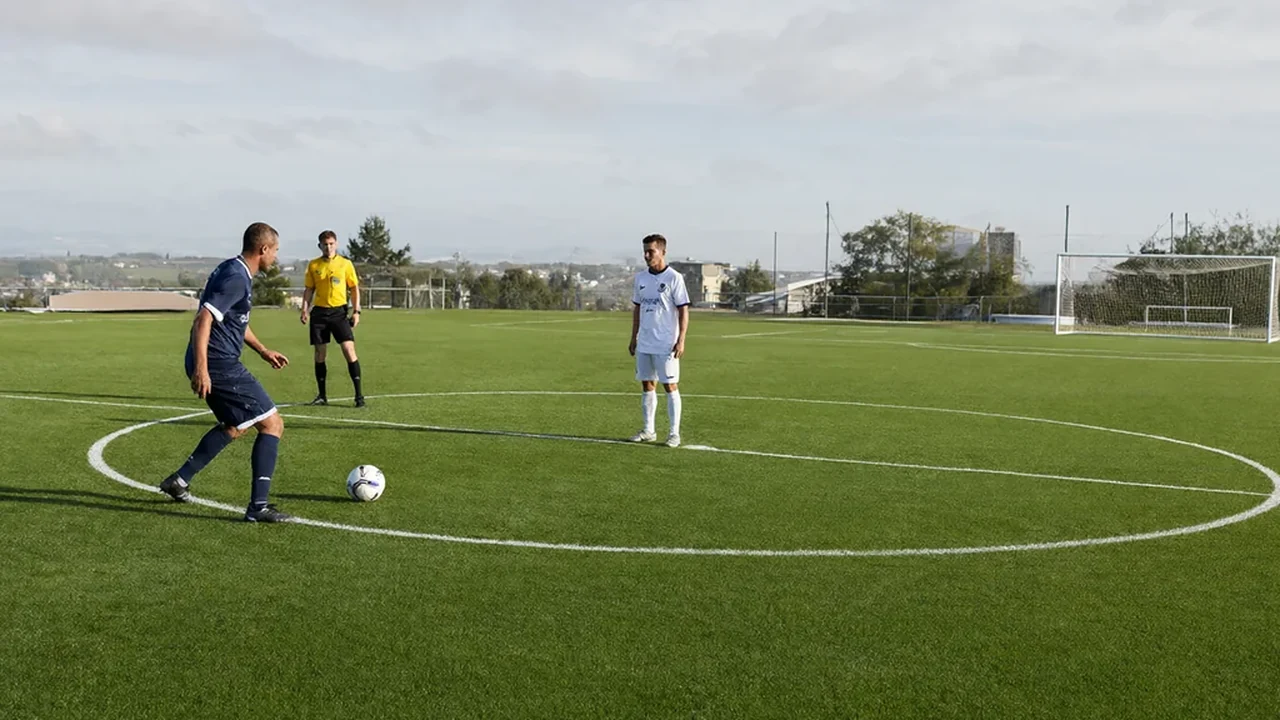
Law 8 covers two restarts and nothing else: the kick-off and the dropped ball. Between them they begin every match, resume it after every goal, and settle the awkward moments when the referee has to stop play without an offence to punish.
The law is short, which makes it easy to read and easy to misapply. The kick-off has more conditions than most players realise, and the dropped ball has changed more in the last decade than any other restart.
The coin toss and who kicks off
The referee tosses a coin, and the team that wins chooses which goal to attack in the first half or to take the kick-off. The other team takes whatever is left. The team that chose which goal to attack in the first half takes the kick-off to start the second half, and the teams change ends.
After a goal, the kick-off is taken by the team that conceded. Extra time begins with a new coin toss, because the law treats it as a new kick-off, and the same procedure applies.
The conditions for every kick-off
- Position: the ball must be stationary on the centre mark.
- Own half: every player except the kicker must be in their own half of the field.
- Distance: opponents must be at least 9.15 m from the ball until it is in play.
- Signal: the referee gives the signal to start.
- Movement: the ball is in play when it is kicked and clearly moves.
Since 2016 the ball no longer has to go forward. A kick-off played backwards to a centre-back is legal, and the law's only requirement is that the ball clearly moves. A gentle touch that leaves the ball on the centre mark is not enough, and the kick is retaken. The kicker is also allowed to stand inside the opponents' half before the kick, which looks wrong and is expressly permitted.
Goals from a kick-off
A goal may be scored directly against the opponents from a kick-off. If the ball goes directly into the kicker's own goal, a corner kick is awarded to the opponents. That second sentence decides the strange highlight-reel cases, and it applies however deliberate the back-pass looked.
Offences at a kick-off
If the kicker touches the ball again before it has touched another player, an indirect free kick is awarded, or a direct free kick for a handball offence. For any other breach of the kick-off procedure, the kick-off is retaken.
| Restart | How it starts | Ball in play when | Direct goal |
|---|---|---|---|
| Kick-off to start a half | Ball on centre mark, opponents 9.15 m away | Kicked and clearly moves | Yes, against opponents |
| Kick-off after a goal | Taken by the team that conceded | Kicked and clearly moves | Yes, against opponents |
| Dropped ball in the penalty area | For the defending goalkeeper in the area | Touches the ground | No |
| Dropped ball outside the area | For a player of the team with or due possession | Touches the ground | No |
| Re-drop | Touched before the ground or out of play untouched | Dropped again | No |
Restarts that belong to other laws
Law 8 is not the whole list of restarts. Free kicks, penalty kicks, throw-ins, goal kicks and corner kicks are dealt with in Laws 13 to 17, and each has its own procedure. Law 8 supplies the kick-off and the dropped ball, the two restarts that exist because play is beginning or because play was stopped without an offence.
One sentence in the introduction applies to all of them: if an offence occurs when the ball is not in play, this does not change how play is restarted. A push in the wall before a corner is still a corner, with a card attached to the offender, not a free kick.
How the dropped ball works
The dropped ball is the restart when the referee stops play and no other restart is required. The modern version is not a contest. If the ball was inside a penalty area when play stopped, it is dropped for the defending goalkeeper in that area. If it was outside, it is dropped for one player of the team that had or would have gained possession, if the referee can determine that; otherwise for a player of the team that last touched it.
All other players, from both teams, must stay at least 4 m from the ball until it is in play. The ball is in play when it touches the ground, and from that moment anyone may challenge for it, including an opponent who started 4 m away.
Why the dropped ball favours possession
The 2019 rewrite turned the dropped ball from a scramble into a possession-based restart. The referee no longer drops the ball between two players; it goes to the team that had it, or would have gained it, and everyone else must retreat 4 m.
That is also why the dropped ball is used for injuries. When the referee stops play because a player is seriously hurt, the team in possession is not punished for the stoppage; it gets the ball back where play stopped.
When the ball is dropped again
The ball is dropped again if it touches a player before it touches the ground, or if it leaves the field of play after touching the ground without touching a player. Those two conditions cover almost every mishap, from a gust of wind to a player who lunges too early.
If a dropped ball enters the goal without touching at least two players, the restart is a goal kick when it goes into the opponents' goal and a corner kick when it goes into the team's own goal. Nobody can score directly from a dropped ball, which is the cleanest summary of the procedure.
Three common misunderstandings
- A kick-off must go forward: false since 2016, the ball only has to move.
- Anyone can score from a dropped ball: false, it must touch two players first.
- A dropped ball is a contest: false, opponents must stay 4 m away until it touches the ground.
The referee's signal matters as much as the ball. A kick-off taken before the whistle is retaken, and so is one where an opponent encroaches inside the 9.15 m radius. The law does not ask whether the encroachment was deliberate.
None of this makes the dropped ball popular. It is the restart nobody wants and every referee has to sell, usually with an arm raised and a short explanation. The law is written to make that explanation easy: possession decides, distance protects the restart, and the ground decides when play resumes. For the offences that produce a free kick instead, see the Law 12 guide; for the wider map of the book, start with all 17 laws explained.
Read next
Law 1: The Field of Play, Measured
Every match starts with a rectangle. Law 1 sets its dimensions, its lines and the marks that decide penalties and goal kicks.
2026-10-18
Law 2: The Ball, and What Makes It Legal
Circumference, weight, pressure and the dropped ball after a burst: Law 2 in the numbers the officials actually use.
2026-10-18
Law 3: How Many Players and How Many Subs
Eleven to start, seven to continue, five substitutions from three opportunities: the numbers and procedures in Law 3.
2026-10-18