Law 13 Free Kicks: Direct, Indirect and the Wall
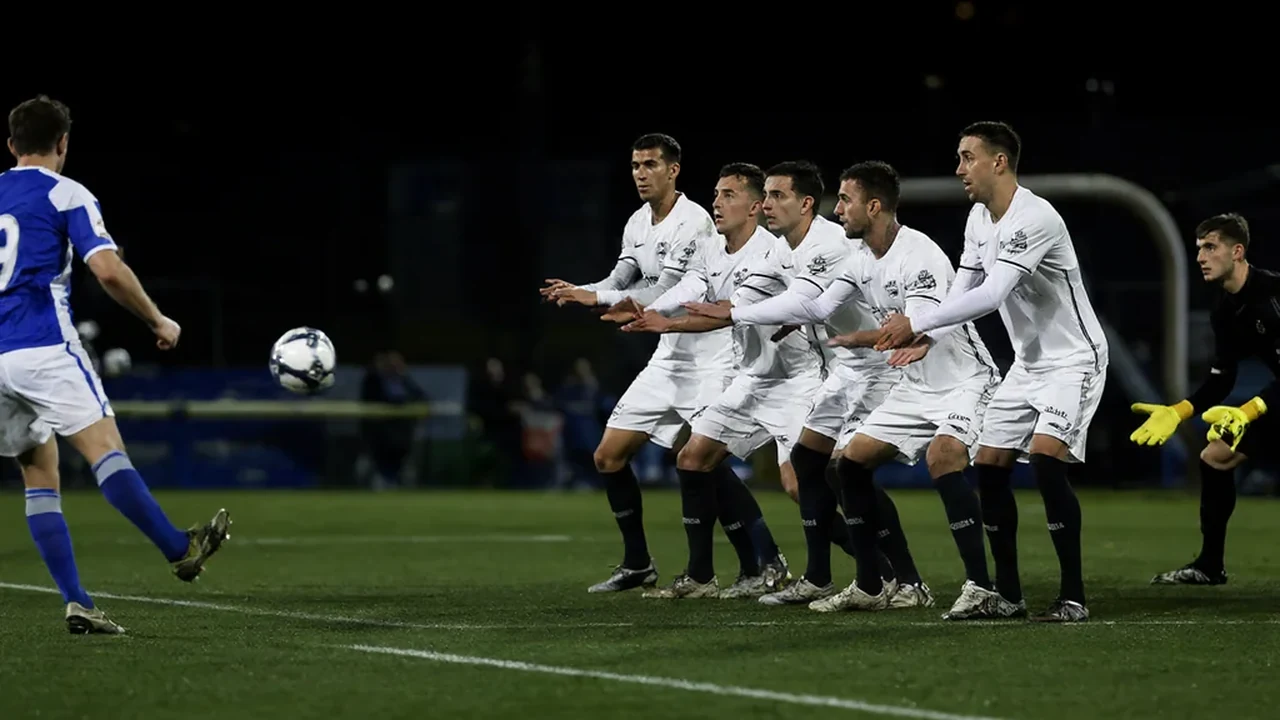
A free kick is the most common restart in football and the one players argue about most, usually about the wall. Law 13 covers both types, the direct and the indirect, and it answers three questions that decide most incidents: where the ball goes, how far opponents must stand, and whether a goal can be scored without a second touch.
The distinction between the two kicks is not cosmetic. A goal may be scored directly from a direct free kick. A goal may not be scored directly from an indirect free kick, because the ball must touch another player first. Everything that follows, including the referee's arm in the air, exists to make that difference visible to everyone in the ground.
Direct and indirect free kicks
A direct free kick is awarded for the more serious offences, the contact offences in Law 12 that are punished when committed carelessly, recklessly or with excessive force, plus deliberate handball. An indirect free kick covers the rest: offside, the goalkeeper's handling offences, dangerous play without contact, and the various technical infringements that carry no contact at all. A direct free kick cannot be awarded inside the offending team's own penalty area, because a direct free kick offence committed there becomes a penalty kick instead.
The signal and what it protects
The referee indicates an indirect free kick by raising an arm above the head, and that arm stays up until the kick has been taken and the ball touches another player, goes out of play, or it becomes clear that a goal cannot be scored directly. The signal is part of the law, not a courtesy. If the referee fails to give it and the ball is kicked directly into the goal, the indirect free kick must be retaken.
The consequences of the ball entering the goal are set out plainly. A direct free kick kicked directly into the opponents' goal is a goal. An indirect free kick kicked directly into the opponents' goal is a goal kick. Either type kicked directly into the team's own goal is a corner kick to the opponents, which is why an attempted clearance from a free kick near the halfway line can end in a corner rather than a goal.
Where the ball is placed
All free kicks are taken from the place where the offence occurred, with a short list of exceptions. An indirect free kick to the attacking team for an offence inside the opponents' goal area is taken from the nearest point on the goal area line that runs parallel to the goal line. A free kick to the defending team in their own goal area may be taken from anywhere in that area. Free kicks for offences involving a player entering, re-entering or leaving the field without permission are taken from the position of the ball when play was stopped, and an offence committed off the field restarts with a free kick on the boundary line nearest to where it happened, or a penalty kick if that point is inside the offender's penalty area.
Ten yards, one metre and the wall
The ball must be stationary and is in play when it is kicked and clearly moves. Until then every opponent must stay at least 9.15 m (10 yds) from the ball, unless they are on their own goal line between the goalposts, and they must be outside the penalty area when a free kick is taken inside the opponents' penalty area.
The wall has its own rule. Where three or more defending players form a wall, every attacking player must stay at least 1 m (1 yd) from that wall until the ball is in play, and an attacking player who stands closer concedes an indirect free kick. The one metre was added to stop the practice of a striker standing shoulder to shoulder with the end of the wall to distract the keeper, and it is one of the easiest offences in the lawbook to spot from the touchline.
| Situation | Where the ball goes | What the opponents must do |
|---|---|---|
| Free kick outside the penalty area | Where the offence occurred | At least 9.15 m (10 yds) from the ball |
| Free kick inside the opponents' penalty area | Where the offence occurred | Outside the penalty area and at least 9.15 m from the ball |
| Indirect free kick to the attack inside the opponents' goal area | Nearest point on the goal area line parallel to the goal line | At least 9.15 m from the ball |
| Free kick to the defending team in their own goal area | Anywhere inside the goal area | Outside the penalty area |
| Wall of three or more defenders | Unchanged | Attacking players at least 1 m (1 yd) from the wall |
| Offence off the field of play | On the boundary line nearest to the offence | At least 9.15 m from the ball |
The quick free kick and the trick
Two details separate a well coached team from a lucky one. The first is the quick free kick: if a player takes the kick quickly and an opponent who is still inside 9.15 m intercepts it, the referee allows play to continue, because the kicking team chose to take the risk. An opponent who deliberately prevents a free kick from being taken quickly, by standing over the ball or blocking the run, is cautioned for delaying the restart.
The second is what the law permits with the ball itself. A free kick can be taken by lifting the ball with a foot or both feet, and feinting to take a free kick in order to confuse opponents is permitted as part of football, which is the opposite of the rule at a penalty kick. If a player correctly taking a free kick deliberately kicks the ball at an opponent in order to play it again, but not carelessly, recklessly or with excessive force, the referee allows play to continue.
The remaining offences are mechanical. If an opponent is closer to the ball than the required distance when the kick is taken, the kick is retaken unless the advantage can be applied. A defender who takes a quick free kick from inside their own penalty area is allowed to do so even if opponents have not had time to leave, but an opponent who then touches or challenges for the ball before it is in play forces a retake. If the kicker touches the ball again before it has touched another player, an indirect free kick is awarded, upgraded to a direct free kick or a penalty kick when the second touch is a handball offence.
None of this works without the referee selling the distance, and the wider structure of that authority is set out in the referee's powers and duties. The offences that produce most free kicks are collected in Law 12 fouls and misconduct, and the corner that follows an own goal from a free kick is covered in the corner kick explained.
Read next
Law 1: The Field of Play, Measured
Every match starts with a rectangle. Law 1 sets its dimensions, its lines and the marks that decide penalties and goal kicks.
2026-10-18
Law 2: The Ball, and What Makes It Legal
Circumference, weight, pressure and the dropped ball after a burst: Law 2 in the numbers the officials actually use.
2026-10-18
Law 3: How Many Players and How Many Subs
Eleven to start, seven to continue, five substitutions from three opportunities: the numbers and procedures in Law 3.
2026-10-18